
Benefit Activities
Benefit companies voluntarily pursue, in the exercise of their business activity, not only the aim of profit, but also one or more purposes of common benefit
Benefit companies voluntarily pursue, in the exercise of their business activity, in addition to the profit motive, also one or more purposes of common benefit, or rather they pursue in a responsible, sustainable and transparent way and without enjoying economic or fiscal incentives, one or more positive effects on people, communities, territories and the environment, cultural and social assets and activities, bodies and associations and other stakeholders.
The origins of Benefit companies
They were born thanks to a global movement of companies, the certified B. Corp®, which, starting from 2006, managed to draft a legislative proposal, which merged into the 2016 stability law, which came into force starting from 1 January 2016. The management of benefit companies requires a balance between the interests of the members and the interest of the community and they undertake to report their activities in a transparent and complete manner through an annual report of impact, which describes both the actions carried out and the plans and commitments for the future.
Purpose, accountability and transparency: a paradigm shift
A benefit corporation is a traditional corporation with modified obligations that hold management and shareholders to higher standards of purpose, accountability and transparency.
Purpose: benefit corporations are committed to creating a positive impact on society and the biosphere, i.e. shared value, as well as generating profit. Sustainability is an integral part of their business model and SBs create conditions conducive to social and environmental prosperity, today and in the future.
Responsibility: benefit corporations are committed to considering the company's impact on society and the environment in order to create long-term sustainable value for all stakeholders.
Transparency: benefit companies are required to annually communicate and report according to third-party standards the results achieved, their progress and future commitments towards achieving social and environmental impact, both towards shareholders and the general public.
This implies a change in the corporate paradigm: with Benefit Companies, a new type of company is introduced which continues to pursue the profit aim but combines it with one or more social or public utility purposes. This implies that a benefit corporation brings benefits for all company stakeholders, for customers and suppliers, for talent, for shareholders and management and a balance of financial and non-financial interests when making decisions, even when faced with a sale hypothesis, or for companies listed on the stock exchange, helping to attract impact investment capital as it offers greater legal protections, responsibility and transparency in pursuing its mission.
Businesses for the "common benefit"
A benefit corporation must be used to achieve a Common Benefit, as well as to generate profits for shareholders. In Italy, as in some US states, Colorado and Delaware, it is required to indicate a Specific Common Benefit in the statute and not just a generic one. The Common Benefit is defined by law as a material positive impact on society and the environment. Among the specific purposes of Beneficio Comune we mention, for example: providing goods or services for disadvantaged individuals or communities; protect or restore the environment; improve human health; promote the arts, sciences or the advancement of knowledge; increase capital flows towards entities that create a common benefit (impact investments).
The Benefit activity of POWERgrass
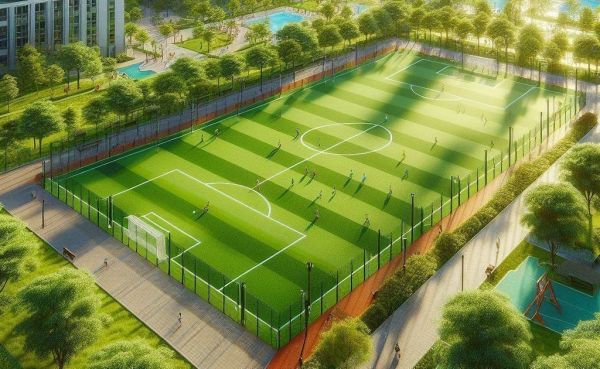
Developing a green project for an intensively used sports field is complex because so far institutional investors have only aimed at synthetic grass fields. Changing minds is not easy because innovative hybrid surfaces are not sufficiently widespread, there is a lack of reference regulations which, among other things, are difficult to develop and, as often happens, there is a lot of improvisation. Green incentives help examine the green alternative but there is not enough knowledge to develop projects to draw on funding and without an effective project even funding seems wasted.
SHOW THE WAY TO THE GREEN ALTERNATIVE
In the common imagination, the synthetic grass field means little maintenance while the natural grass field is impassable when it rains. Convincing investors that there is an effective green alternative goes far beyond the technical-commercial proposal that a company offers; then companies often tend to do what the customer wants without and look at innovations with distrust.
POWERgrass' benefit activity is centered on disseminating knowledge for the management of green areas for sports use and assisting public bodies, associations and sports promotion bodies that operate in the non-profit world to draw on non-repayable funding.
The Benefit activity, carried out free of charge, takes place through consultancy for the development of feasible strategic plans and direct support to the technicians of public bodies to develop and contextualize green projects, adhering to state and regional tenders.
The POWERgrass study compares three types of intensive use fields for thirty years, as also required by the Environmental Impact Study (EIS) and aims to be a real guide for drawing up a Feasibility Study with a holistic vision.
The Benefit activity was launched from mid-July 2020 until October 30, 2020, the company assisted approximately 8 municipalities and 2 sports associations to complete and present a project with the request for non-repayable financing. Three of them managed to pass the technical-administrative checks and enter the ranking and therefore all three obtained a non-repayable loan of 700 thousand each.
Since November 2020, the company has contacted around 400 municipal administrations to provide planning support for the development of green projects for future tenders.
Two people from the company are involved in the Benefit activity and talk daily with municipalities intending to develop a project for a grass sports field.
THE EDUCATIONAL METHOD OF ECOLOGICAL MAINTENANCE
Administrators and managers are terrified of the costs of maintaining natural grass playing fields; the task then becomes difficult for the technicians when the weather is rainy but this is no longer a problem for POWERgrass. It is precisely for this reason that a draining and effective hybrid system has been developed with a simple, economical and ecological maintenance method.
The method developed by POWERgrass is disseminated through its website where numerous in-depth pages and several instructive videos are developed on the YouTube channel. Furthermore, POWERgrass provides an expert maintenance technician free of charge for one year so that the customer can perfectly understand the best practice for maintaining his hybrid field. Publications, advice, training courses and information meetings are part of the dissemination of the teachings of regenerative agriculture which are offered without obligation to purchase products or services.
ON REGENERATIVE AGRICULTURE WE ARE REWRITING THE MANUALS OF THE FUTURE
Nature over millennia has established biological links between all beings in the food chain while maintaining a harmonious balance. However, man with the model of intensive agriculture adopted after the war in Italy and around the world had the objective of maximizing yields through the excessive use of chemical fertilizers and pesticides to suppress diseases and pests. These had a devastating effect on the biological activity in the soil which in fact quickly made it almost sterile, demineralizing and washing it away.
A growing number of scholars embrace an innovative plant production model also known as regenerative agriculture. It is a modern cultivation technique that focuses on the balance of natural processes between microorganisms and plants to obtain healthy, quality products. It all depends on the enrichment of the soil with noble organic substance capturing carbon during the photosynthesis process and then making it available to the microorganisms in the soil.
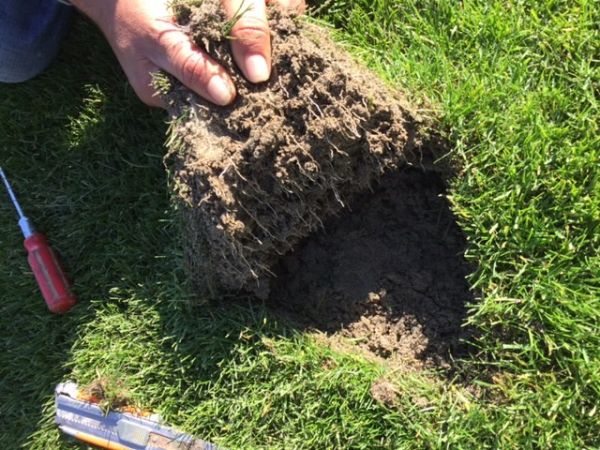
The application of the teachings of regenerative agriculture in the turf of a sports field brings notable benefits where the only limit is that of intensive trampling because it compresses the porosity, altering the physical properties of the soil, limiting the gaseous exchange between the soil and the air. Lightening the soil regularly guarantees the gas exchange (CO2 ⇄ O2) necessary for biological processes. In the draining and well-aerated substrate the microorganisms proliferate and mineralize forms of nutrients inaccessible to the plants. Frequently cutting and allowing the grass residues to settle on the soil, a part of the nutrients they return to the circle thanks to biological activity.
From the point of view of environmental impact, among the advantages of turf cared for in symbiosis with the biological activity in the soil, it can be summarized that a cared for turf:
- quickly absorbs rainwater and prevents it from flowing onto the surface which causes flooding,
- conserves and reuses rainwater for the growth of natural grass because it is retained in the substrate due to capillary forces,
- recharges the aquifers with biologically filtered water, because the excess water is partly dispersed through the drains into the underlying ground and partly is collected in the accumulation tanks for subsequent irrigation reuse,
- sequesters up to 8 times more CO2 from the air than a normal lawn, simply optimizing the photosynthesis process,
- contributes to reducing air temperature to improve comfort for players and spectators and
- captures a greater quantity of fine dust present in the air thanks to greater transpiration,
- produces a greater quantity of oxygen because it is simply the waste from the photosynthesis process.
Only through soil regeneration, can we have a positive environmental impact. Maintaining all green spaces with regenerative agriculture is the only method to combat pollution in our cities. It is everyone's responsibility which pays off in our health by also offering a prestigious aesthetic appearance.
REGENERATIVE AGRICULTURE MAKES CROPS RESILIENT
Our agricultural production is based on soil cultivation, plowing and the use of synthetic fertilizers and pesticides as it has become a tradition in recent decades that is difficult to change. However, people are more willing to change when they are faced with a problem they don't understand or when they don't have enough knowledge to solve it.
This is the case of the Milan racecourse where the attack of the insects forced the owners to stop the races in August 2021 after the larvae of Popillia Japonica ate the roots of the grass and the horses slipped during the race. POWERgrass applied its knowledge for the first time in such a large area and 4 weeks later the horses were racing on the tracks again.
In the following link you can download the reports of our Benefit activity for 2021 and 2022.
Attachments

Insights






FAQ 12
Environmental regulations and the field

Write to Us
For any kind of request write to us.