Successful installation

The correct installation of a hybrid system requires particular attention.
  • Published 28/02/2024   Focus on
  •  by POWERgrass

  1. Hirea manager who is expert in turf maintenance and I think if he is a former footballer, because he must understand both the needs of the grass and what is good for the players, he knows how to talk with them and also with the client's managers, regarding the needs of the grass, when and how to use the pitch.
  2. Always use a system with 24 sprinklers (4x6) to avoid sprinklers in the central line of play, where foot traffic from players is much higher: if the pitch is around 6000-7000 m2 we recommend the Rainbird 8005S type sprinkler with the clod holder cup for those inside the playing area and the Toro TS90 if the pitch is 8000-9000 m2
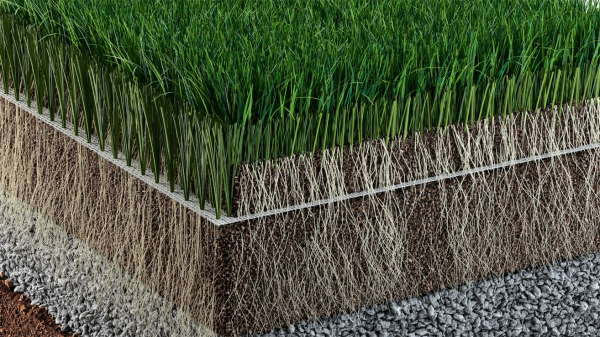
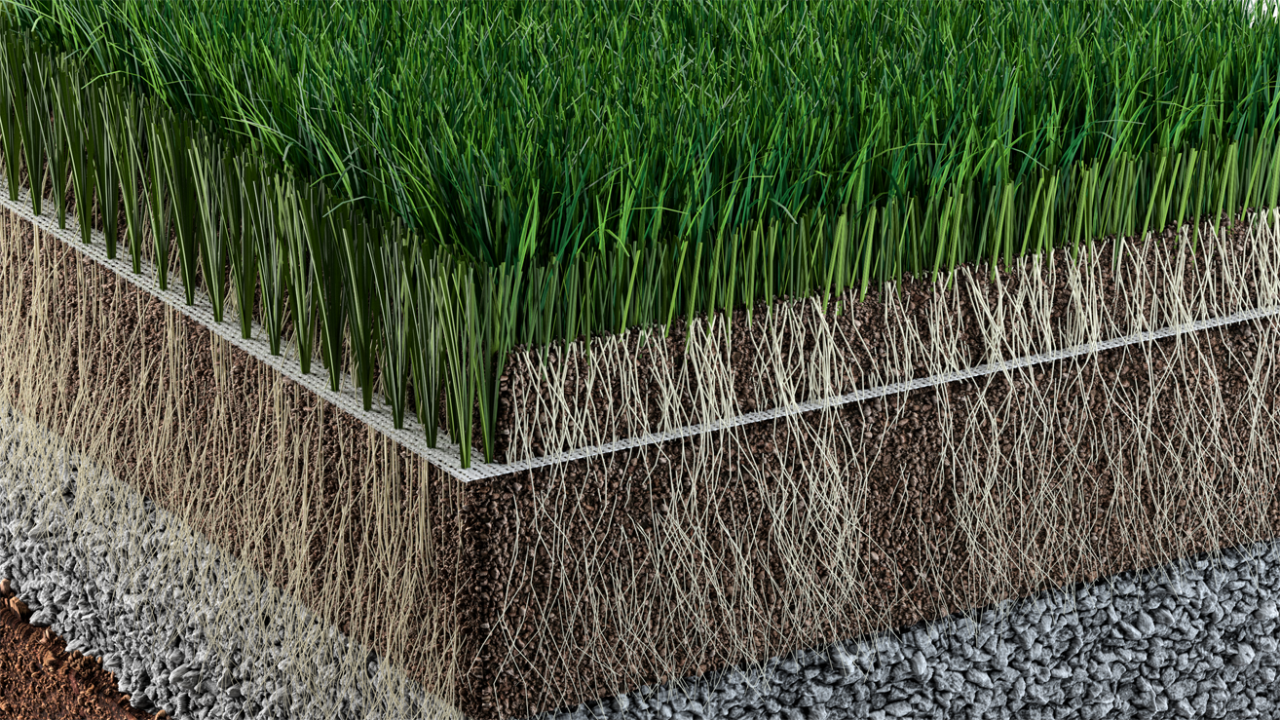
  3. The surface must be well leveled and compacted to avoid settling. The tolerance of your laser must be less than 10 mm across the entire field area, because uniformity is important considering that we use very light growth and drainage layers: 80 mm of gravel and 80 mm of sand under the hybrid mat. If the ground forms a depression after installing the hybrid turf system, you must correct it by cutting and raising the carpet but then it is difficult to sew it up. Around the sprinkler, the layers of gravel and sand must be compacted with a road plate to ensure that they do not deform the surface. To obtain perfect compaction of the sand layer, it is necessary to saturate the sand with irrigation and then compact it with a double vibrating drum roller weighing at least 4-5 tons.
  4. Natural grass grows better within the POWERgrass hybrid blanket because it offers a thermal insulation effect that protects the roots from abiotic stress. So in those areas where the climate outside the range of 10-28°C for a long time (hot or cold), it is recommended to cover the entire surface with hybrid turf so the whole picture appears more uniform even in the surroundings. In this case, the length of the rolls of the hybrid turf must be equal to the short side of the field also because stitching the rolls at the head can be complex and anesthetic, at least until the natural grass grows.
  5. Sewing the rolls sideways together is not difficult but you must be careful to do it close to the first row of synthetic fibres. To join the rolls together you need to fold one over the other, lift and align both, then sew with a portable double thread machine, such as those used to sew bags of agricultural products. After sewing, cut the selvages 15 mm apart from the seams. After sewing all the rolls together, before starting the infill you need to use a plastic rake with three short teeth to lift the fibers that are trapped in the seams.
  6. When proceeding with the infill of the hybrid covering you must start with the cork first. Use a small 4 mm diameter spring harrow carried by the tractor and at the same time tow a mesh leveling net, such as Keystone, to lift all the synthetic fibres. Then continue with the sand/zeolite mixture in layers of 7-8 mm and lift the fibers each time. Depending on the size and shape of the sand, the surface may not be as stable as cars pass by and tire marks will be seen when filling the carpet; in this case use the road roller to remove them after obviously passing the harrow and before proceeding with the next coat of filling. Always employ two men with hand rakes to correct imperfections and allow them to fill and rake edges evenly. If there are areas where excess sand has been applied, it may be necessary to lift the fibers manually by raking. The appearance of the pitch must be totally green and ready to play like any artificial pitch before sowing.
  7. In the POWERgrass hybrid system, we observed that sowing on the surface without disturbing the seed much favors rapid emergence. In the case of sowing with perennial lolium we recommend the Amazone GNK type seeder with the rear roller which exerts a light rolling. In case of sowing macrothermal plants such as Bermuda grass or Paspalum vaginatum, we recommend using the Drop Spreader SS-2 type trolley from ICL.
  8. The substrate of sand/zeolite in a percentage ratio of 90/10 has so far provided the best results. However, supplementing with the right combination of organic soil amendments, biological inoculants, organic and mineral fertilizers are very important because it allows us to grow grass quickly, safely and without the use of pesticides, achieving success where others fail. In hot weather, excess moisture in the soil and air can damage grass more than anything else.
  9. Water management, especially if the climate is hot, is imperative to prevent the grass from drying out but even worse from being boiled where the heat and humidity are too high. Using a professional control unit from Agronic with soil probes positioned at two levels (at -35 and minus 100 mm) and air probes to better understand the growing conditions and modify the irrigation strategy. In fact, watering must adapt to the change in climate, especially when it goes from hot and dry to hot and humid. It must be kept in mind that under the hybrid cover evaporation is reduced, so it is necessary to water enough every day to keep the upper part of the infill in the range of 13-16% humidity. You can balance this when you learn to interpret the probe readings but of course you should always ask for daily feedback from the relevant person on the site. Using a pump capable of providing a volume of water sufficient for 4 sprinklers plus 20% (depends on the size of the nozzle and the nozzle depends on the radius to be covered for the same sprinkler) at at least 8 atm, allows you to intervene quickly to supply water in a short time, even saving water and electricity.
  10. In winter, by keeping the humidity of the infill above 13-16%, there is less risk of frost phenomena and when this occurs the thaw during a sunny day is quicker.
Please note: the worst period for sowing is when the climate is hot and humid, with temperatures higher than the ideal range for the essence sown and in the absence of wind. Since we are forced to continually wet the surface to maintain humidity, the humidity in the air also tends to increase, therefore the heat accumulated as in a Turkish bath. This risk is moderate in ventilated areas and for this reason where the weather becomes a determining factor it is best to adopt cooling systems to improve ventilation first and foremost. In some cases, the use of nebulization is also recommended, so the best tool is snow cannons with or without water.
Successful installation

Sezione_POWERgrass_2021rid2_1

  • 28/02/2024
  • Italgreen Landscape

  1. Hirea manager who is expert in turf maintenance and I think if he is a former footballer, because he must understand both the needs of the grass and what is good for the players, he knows how to talk with them and also with the client's managers, regarding the needs of the grass, when and how to use the pitch.
  2. Always use a system with 24 sprinklers (4x6) to avoid sprinklers in the central line of play, where foot traffic from players is much higher: if the pitch is around 6000-7000 m2 we recommend the Rainbird 8005S type sprinkler with the clod holder cup for those inside the playing area and the Toro TS90 if the pitch is 8000-9000 m2
  3. The surface must be well leveled and compacted to avoid settling. The tolerance of your laser must be less than 10 mm across the entire field area, because uniformity is important considering that we use very light growth and drainage layers: 80 mm of gravel and 80 mm of sand under the hybrid mat. If the ground forms a depression after installing the hybrid turf system, you must correct it by cutting and raising the carpet but then it is difficult to sew it up. Around the sprinkler, the layers of gravel and sand must be compacted with a road plate to ensure that they do not deform the surface. To obtain perfect compaction of the sand layer, it is necessary to saturate the sand with irrigation and then compact it with a double vibrating drum roller weighing at least 4-5 tons.
  4. Natural grass grows better within the POWERgrass hybrid blanket because it offers a thermal insulation effect that protects the roots from abiotic stress. So in those areas where the climate outside the range of 10-28°C for a long time (hot or cold), it is recommended to cover the entire surface with hybrid turf so the whole picture appears more uniform even in the surroundings. In this case, the length of the rolls of the hybrid turf must be equal to the short side of the field also because stitching the rolls at the head can be complex and anesthetic, at least until the natural grass grows.
  5. Sewing the rolls sideways together is not difficult but you must be careful to do it close to the first row of synthetic fibres. To join the rolls together you need to fold one over the other, lift and align both, then sew with a portable double thread machine, such as those used to sew bags of agricultural products. After sewing, cut the selvages 15 mm apart from the seams. After sewing all the rolls together, before starting the infill you need to use a plastic rake with three short teeth to lift the fibers that are trapped in the seams.
  6. When proceeding with the infill of the hybrid covering you must start with the cork first. Use a small 4 mm diameter spring harrow carried by the tractor and at the same time tow a mesh leveling net, such as Keystone, to lift all the synthetic fibres. Then continue with the sand/zeolite mixture in layers of 7-8 mm and lift the fibers each time. Depending on the size and shape of the sand, the surface may not be as stable as cars pass by and tire marks will be seen when filling the carpet; in this case use the road roller to remove them after obviously passing the harrow and before proceeding with the next coat of filling. Always employ two men with hand rakes to correct imperfections and allow them to fill and rake edges evenly. If there are areas where excess sand has been applied, it may be necessary to lift the fibers manually by raking. The appearance of the pitch must be totally green and ready to play like any artificial pitch before sowing.
  7. In the POWERgrass hybrid system, we observed that sowing on the surface without disturbing the seed much favors rapid emergence. In the case of sowing with perennial lolium we recommend the Amazone GNK type seeder with the rear roller which exerts a light rolling. In case of sowing macrothermal plants such as Bermuda grass or Paspalum vaginatum, we recommend using the Drop Spreader SS-2 type trolley from ICL.
  8. The substrate of sand/zeolite in a percentage ratio of 90/10 has so far provided the best results. However, supplementing with the right combination of organic soil amendments, biological inoculants, organic and mineral fertilizers are very important because it allows us to grow grass quickly, safely and without the use of pesticides, achieving success where others fail. In hot weather, excess moisture in the soil and air can damage grass more than anything else.
  9. Water management, especially if the climate is hot, is imperative to prevent the grass from drying out but even worse from being boiled where the heat and humidity are too high. Using a professional control unit from Agronic with soil probes positioned at two levels (at -35 and minus 100 mm) and air probes to better understand the growing conditions and modify the irrigation strategy. In fact, watering must adapt to the change in climate, especially when it goes from hot and dry to hot and humid. It must be kept in mind that under the hybrid cover evaporation is reduced, so it is necessary to water enough every day to keep the upper part of the infill in the range of 13-16% humidity. You can balance this when you learn to interpret the probe readings but of course you should always ask for daily feedback from the relevant person on the site. Using a pump capable of providing a volume of water sufficient for 4 sprinklers plus 20% (depends on the size of the nozzle and the nozzle depends on the radius to be covered for the same sprinkler) at at least 8 atm, allows you to intervene quickly to supply water in a short time, even saving water and electricity.
  10. In winter, by keeping the humidity of the infill above 13-16%, there is less risk of frost phenomena and when this occurs the thaw during a sunny day is quicker.
Please note: the worst period for sowing is when the climate is hot and humid, with temperatures higher than the ideal range for the essence sown and in the absence of wind. Since we are forced to continually wet the surface to maintain humidity, the humidity in the air also tends to increase, therefore the heat accumulated as in a Turkish bath. This risk is moderate in ventilated areas and for this reason where the weather becomes a determining factor it is best to adopt cooling systems to improve ventilation first and foremost. In some cases, the use of nebulization is also recommended, so the best tool is snow cannons with or without water.

Condividi su

Categorie

Tags

Archivio


Successful installation

Focus on / 28/02/2024

  1. Hirea manager who is expert in turf maintenance and I think if he is a former footballer, because he must understand both the needs of the grass and what is good for the players, he knows how to talk with them and also with the client's managers, regarding the needs of the grass, when and how to use the pitch.
  2. Always use a system with 24 sprinklers (4x6) to avoid sprinklers in the central line of play, where foot traffic from players is much higher: if the pitch is around 6000-7000 m2 we recommend the Rainbird 8005S type sprinkler with the clod holder cup for those inside the playing area and the Toro TS90 if the pitch is 8000-9000 m2
  3. The surface must be well leveled and compacted to avoid settling. The tolerance of your laser must be less than 10 mm across the entire field area, because uniformity is important considering that we use very light growth and drainage layers: 80 mm of gravel and 80 mm of sand under the hybrid mat. If the ground forms a depression after installing the hybrid turf system, you must correct it by cutting and raising the carpet but then it is difficult to sew it up. Around the sprinkler, the layers of gravel and sand must be compacted with a road plate to ensure that they do not deform the surface. To obtain perfect compaction of the sand layer, it is necessary to saturate the sand with irrigation and then compact it with a double vibrating drum roller weighing at least 4-5 tons.
  4. Natural grass grows better within the POWERgrass hybrid blanket because it offers a thermal insulation effect that protects the roots from abiotic stress. So in those areas where the climate outside the range of 10-28°C for a long time (hot or cold), it is recommended to cover the entire surface with hybrid turf so the whole picture appears more uniform even in the surroundings. In this case, the length of the rolls of the hybrid turf must be equal to the short side of the field also because stitching the rolls at the head can be complex and anesthetic, at least until the natural grass grows.
  5. Sewing the rolls sideways together is not difficult but you must be careful to do it close to the first row of synthetic fibres. To join the rolls together you need to fold one over the other, lift and align both, then sew with a portable double thread machine, such as those used to sew bags of agricultural products. After sewing, cut the selvages 15 mm apart from the seams. After sewing all the rolls together, before starting the infill you need to use a plastic rake with three short teeth to lift the fibers that are trapped in the seams.
  6. When proceeding with the infill of the hybrid covering you must start with the cork first. Use a small 4 mm diameter spring harrow carried by the tractor and at the same time tow a mesh leveling net, such as Keystone, to lift all the synthetic fibres. Then continue with the sand/zeolite mixture in layers of 7-8 mm and lift the fibers each time. Depending on the size and shape of the sand, the surface may not be as stable as cars pass by and tire marks will be seen when filling the carpet; in this case use the road roller to remove them after obviously passing the harrow and before proceeding with the next coat of filling. Always employ two men with hand rakes to correct imperfections and allow them to fill and rake edges evenly. If there are areas where excess sand has been applied, it may be necessary to lift the fibers manually by raking. The appearance of the pitch must be totally green and ready to play like any artificial pitch before sowing.
  7. In the POWERgrass hybrid system, we observed that sowing on the surface without disturbing the seed much favors rapid emergence. In the case of sowing with perennial lolium we recommend the Amazone GNK type seeder with the rear roller which exerts a light rolling. In case of sowing macrothermal plants such as Bermuda grass or Paspalum vaginatum, we recommend using the Drop Spreader SS-2 type trolley from ICL.
  8. The substrate of sand/zeolite in a percentage ratio of 90/10 has so far provided the best results. However, supplementing with the right combination of organic soil amendments, biological inoculants, organic and mineral fertilizers are very important because it allows us to grow grass quickly, safely and without the use of pesticides, achieving success where others fail. In hot weather, excess moisture in the soil and air can damage grass more than anything else.
  9. Water management, especially if the climate is hot, is imperative to prevent the grass from drying out but even worse from being boiled where the heat and humidity are too high. Using a professional control unit from Agronic with soil probes positioned at two levels (at -35 and minus 100 mm) and air probes to better understand the growing conditions and modify the irrigation strategy. In fact, watering must adapt to the change in climate, especially when it goes from hot and dry to hot and humid. It must be kept in mind that under the hybrid cover evaporation is reduced, so it is necessary to water enough every day to keep the upper part of the infill in the range of 13-16% humidity. You can balance this when you learn to interpret the probe readings but of course you should always ask for daily feedback from the relevant person on the site. Using a pump capable of providing a volume of water sufficient for 4 sprinklers plus 20% (depends on the size of the nozzle and the nozzle depends on the radius to be covered for the same sprinkler) at at least 8 atm, allows you to intervene quickly to supply water in a short time, even saving water and electricity.
  10. In winter, by keeping the humidity of the infill above 13-16%, there is less risk of frost phenomena and when this occurs the thaw during a sunny day is quicker.
Please note: the worst period for sowing is when the climate is hot and humid, with temperatures higher than the ideal range for the essence sown and in the absence of wind. Since we are forced to continually wet the surface to maintain humidity, the humidity in the air also tends to increase, therefore the heat accumulated as in a Turkish bath. This risk is moderate in ventilated areas and for this reason where the weather becomes a determining factor it is best to adopt cooling systems to improve ventilation first and foremost. In some cases, the use of nebulization is also recommended, so the best tool is snow cannons with or without water.

Pubblicato il 16 Sep, 2026