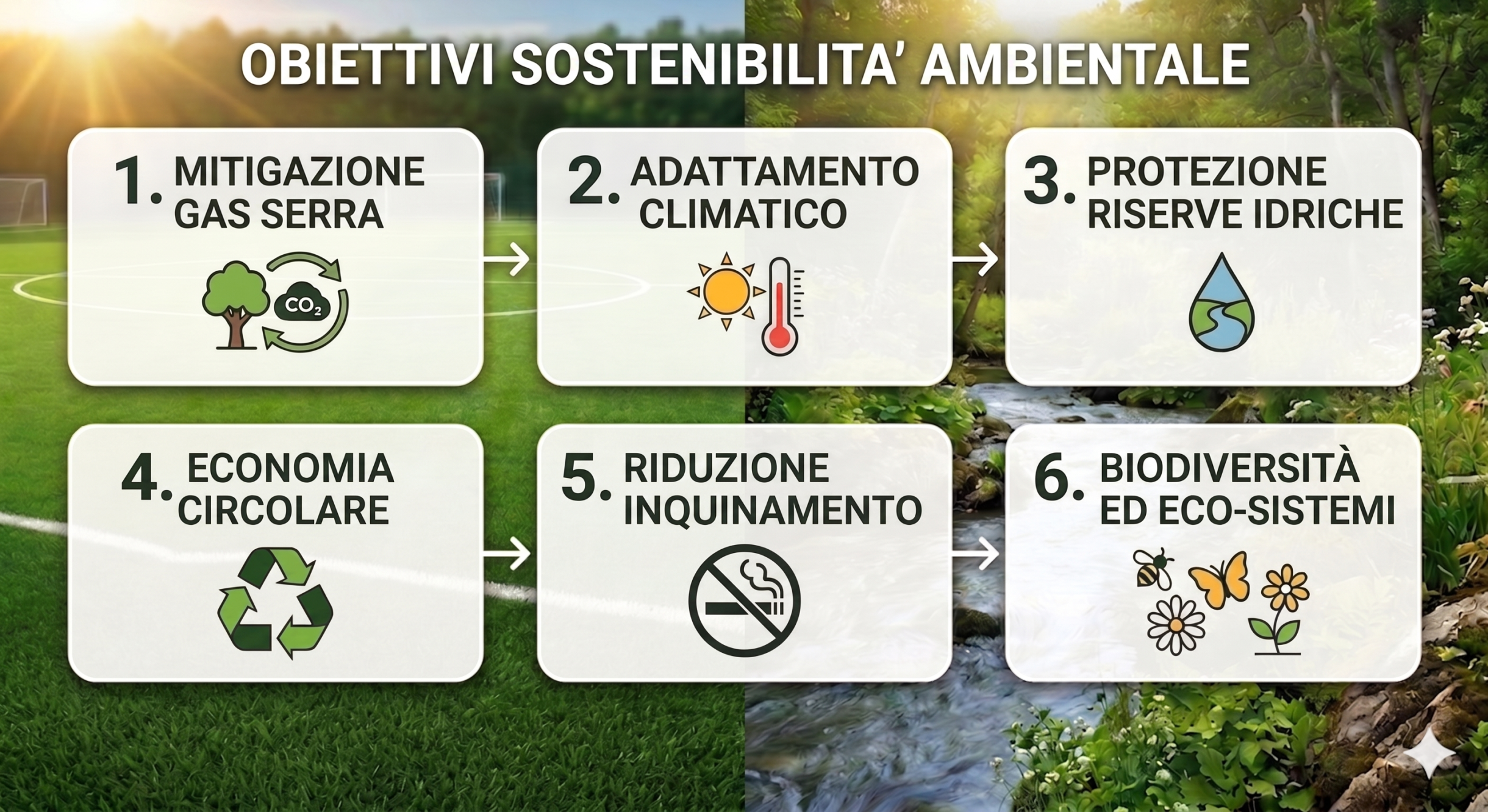
Environmental Objectives
The central pillar of Next Generation EU is the RRF device which, among the various objectives, aims to support interventions that contribute to implementing the Paris Agreement
The central pillar of Next Generation EU is the RRF device which, among the various objectives, aims to support interventions that contribute to implementing the Paris Agreement and the United Nations sustainable development goals, in line with the European Green Deal. The environmental objectives are part of the sustainability report of the new public procurement code.
Environmental objectives and the DNSH principle
The Do No Significant Harm (DNSH) principle, which translated means not causing significant harm, must be respected by all interventions envisaged by the national PNRR: this is fundamental to access RRF funding. Furthermore, the plans must include interventions that contribute 37% of the resources to the ecological transition. The DNSH principle is based on the "Taxonomy for sustainable finance", adopted to promote private sector investments in green and sustainable projects as well as contribute to achieving the objectives of the Green Deal.
The PNRR regulation draws guidelines from the taxonomy, according to which each project, as a minimum measure, must not cause significant damage to any of the environmental objectives:
- mitigation of climate change;
- adaptation to climate change;
- sustainable use and protection of water and marine resources;
- transition towards the circular economy, also with reference to waste reduction and recycling;
- prevention and reduction of pollution of air, water or soil;
- protection and restoration of biodiversity and the health of ecosystems.
A specific technical annex of the Taxonomy (PDF) reports the parameters to evaluate whether the various economic activities contribute substantially to the mitigation and adaptation to climate change or cause significant damage to one of the other objectives. Based on the European system of classification of economic activities (NACE), the activities that can contribute to the mitigation of climate change are identified, identifying the sectors that are crucial for an effective reduction of pollution. The framework defined by the Taxonomy therefore provides a reliable guide so that investment decisions are sustainable, becoming a key element in the criteria for allocating European resources.
Environmental objectives, the DNSH principle and CAM
The environmental objectives of the Taxonomy have been introduced in the sustainability report of the new procurement code, in article 11 of annex I.7 of Legislative Decree 36/2023 therefore, each project must consider the impact on each of the environmental objectives. The guidelines on the synthetic analysis of the DNSH principle and the verification sheets provided for each intervention are fundamental to understand whether the environmental impact complies with the standard or requires an in-depth assessment (EIA).
In the construction phase of (CPV 45236110-4 Surface work for sports fields) or in the extraordinary maintenance phase of (CPV 45236119-7 Repair work for sports fields) the measures provided for in CAM 2.6 of Ministerial Decree no. can be adopted. 256 of 23 June 2022 "Assignment of design services and assignment of works for building interventions" to reduce the impact of the construction site of a sports field:
- CAM 2.6.1 Construction site environmental performance
- CAM 2.6.3 Conservation of the topsoil
- CAM 2.6.4 Backfills and fills
In the construction phase of (CPV 45236114-2 Surface works for athletic tracks) it is also possible to adopt CAM 2.5.10.2 of Resilient Flooring because it is a rubber flooring.
Instead, in the lawn sowing phase (CPV 77314100-5 Turf construction and maintenance services) and above all in the natural grass maintenance phase (CPV 77320000-9 Sports field maintenance services) compliance with the CAM of Ministerial Decree nr. 63 of 10 March 2020 "Minimum environmental criteria for the public green management service and the supply of green care products" can significantly contribute to the environmental impact.

Related topics


Environmental benefits
6 points of merit on our fields
Heat islands
Mitigation and green contribution

Foliar fertilization
What it is, design and application