Green management
Accurate financial planning, throughout the life cycle of a project, allows you to plan with foresight
Accurate financial planning, throughout the life cycle of a work, allows you to plan with foresight to reduce the overall costs of construction, management and even disposal. During design, the environmental impact study (EIS) must also prevent climate variations with at least thirty-year scenarios and each activity must also be studied with regards to the impact on people and the environment.
THE HERITAGE OF PUBLIC GREEN
The “Public Green” is that part of the territory removed from construction to mitigate the impact of excessive construction on the environment. In recent years, however, green maintenance has been neglected due to the lack of funds in current spending. Administrators say that it is easier to find funds for investments but this paradox depends onfinancial planning.
Green management is effective where maintenance is part of the investments also because when it comes to natural greenery, ordinary maintenance prevents extraordinary maintenance.
Fortunately, this is about to change because the current rules of the Minimum Environmental Criteria (CAM) also require an environmental impact study (EIS) of all public works which also includes mitigation and compensation interventions. The study must also project scenarios for at least thirty years which also take into account climate change. In this case, the regulations require a census of public green spaces with an assessment of the state of conservation, as a starting point for drawing up the study (SIA). The final result must produce an environmental management system where monitoring methods must also be integrated to measure and control activities throughout the life cycle of a work, i.e. the phases of construction and redevelopment, use and maintenance and that of decommissioning, also taking into account the impact of the climate on the territory.
The natural grass fields are part of the equipped public green areas and their transformation into synthetic turf in the last two decades has changed the layout of the public green areas. The problem is even more impactful in large municipalities and metropolitan cities because they take away a large part of the natural green heritage with a negative impact on the environment.
However, it must be noted that demand today is oriented towards synthetic fields because it arises from a dual need: 1) the increase in the intensity of play of natural fields, incapable of withstanding intensive trampling and 2) the need to reduce maintenance costs by thinking exclusively of ordinary maintenance. However, in this way the problem is moved further forward because every 8 or 10 years approximately the synthetic field must be redone. Furthermore, in a synthetic field the effects of ordinary maintenance are not easily visible because they are green from the outside. This hides a pitfall because the warranty and extraordinary maintenance are subordinate to ordinary maintenance.
At the end of the management of a sports center it is necessary to deliver the field in a state of equivalent or improved conservation compared to the original state but, in the majority of fields, it is up to the owners again to redo the field.
The incentives on Green projects help to develop more far-sighted innovative ideas with a broader vision of land management.
THE POWERGRASS FIELD AND GREEN MANAGEMENT
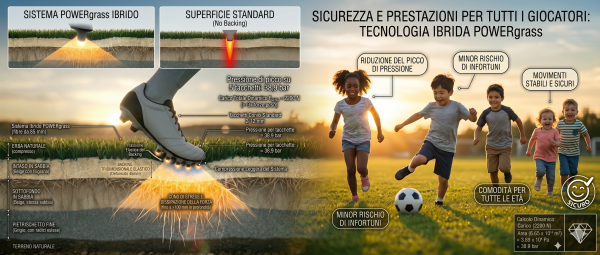
For playgrounds, only a well-thought-out hybrid grass system associated with constant maintenance best satisfies the community's needs in terms of usability, safety of play and sustainability.
Our expert and inventor of the system Dr. Niko Sarris in his speech in the broadcast entitled "Structural reforms and sustainable growth: the role of innovation" broadcast live on the CNBC channel on May 25, 2021, explained a fundamental point of the sustainability of hybrid fields and the role of maintenance which was then positively grasped by Prof. Luigi Conte,President of the National Association of Financial Consultants (ANASF).
The speech of our Dr. Sarris was resumed following the speech of Dr. Giovanni Nava, DG for European Reforms on behalf of Italy.
The management cost is low if multi-year depreciation is taken into account, for the entire life cycle of the asset also because the hybrid field improves the green structure and does not require further mitigation or environmental compensation actions.
The impact is positive if the of regenerative agriculture teachings are applied for the maintenance of natural grass. The hybrid system promotes a circular economy and qualified employment of new profiles of workers, sensitive to caring for the environment.
Furthermore, monitoring of the environmental impact also becomes easier to implement controls, because the natural grass immediately highlights any negligence during the operation phase of the pitch.
The hybrid field project improves the hydrogeological structure because it quickly absorbs rainwater and prevents surface flow which causes soil erosion and the risk of flooding. The rainwater is partly stored in the substrate for the needs of the natural grass and partly recharges the aquifers through the drains, with clean water, biologically filtered by the natural grass.
The solution of an effective hybrid system combines all aspects around the construction, use and maintenance and disposal of grass playing fields with the possibility of controlling and monitoring the impact on the environment.

Insights
The perfect FIFA 2026 pitch
In search of excellence in the perfect field, POWERgrass could not be missing! And now with the first results they confirm...
Show moreThe perfect FIFA 2026 pitch
Sport and Suburbs 2026
It is aimed at municipalities with over 5000 inhabitants, also in associated form, with a focus on the recovery of...
Show more