Feasibility of grass fields
The creation of an eco-efficient grass field requires the definition of numerous objectives
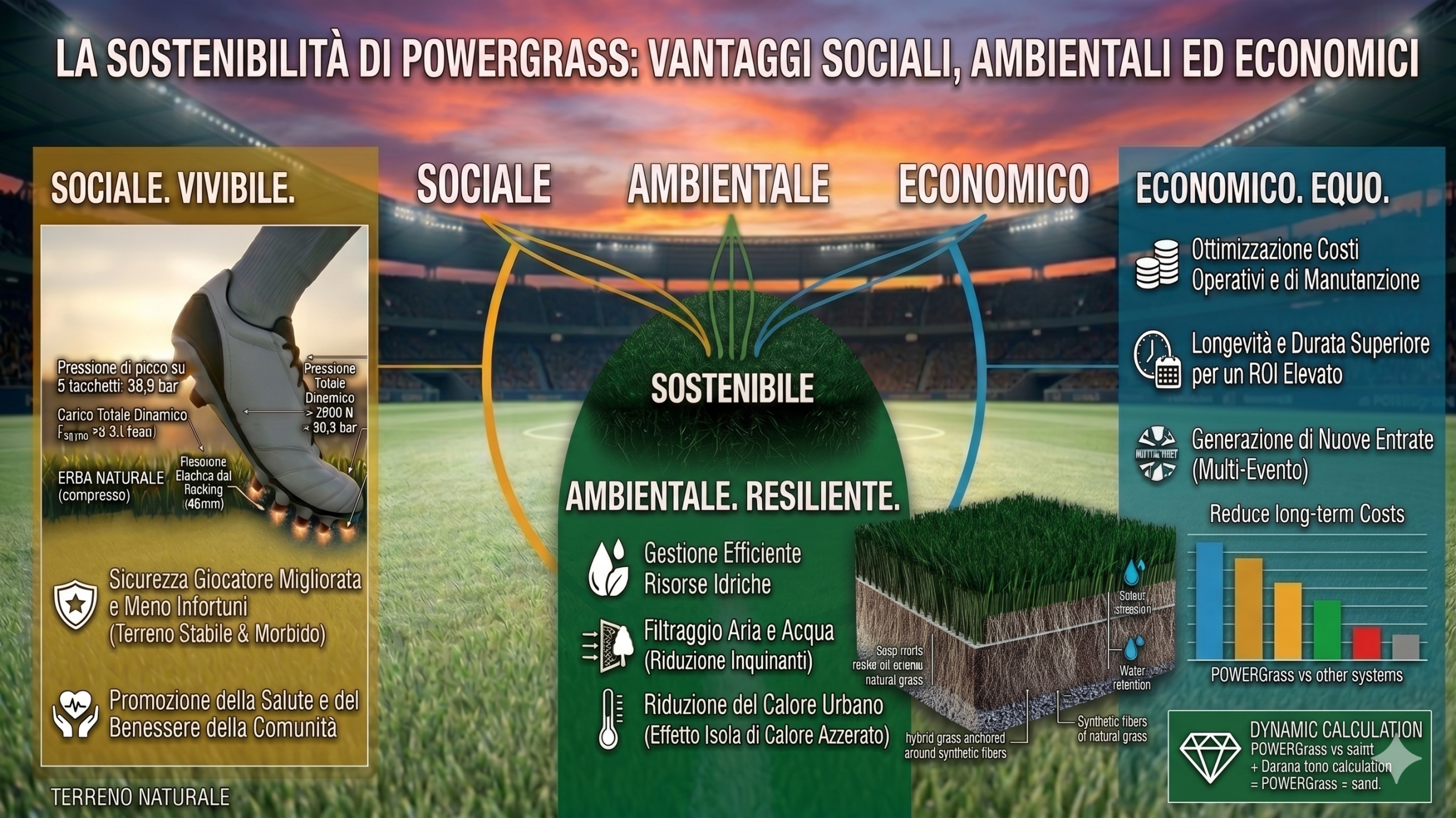
The creation of an eco-efficient grass pitch requires the definition of numerous objectives based on needs and expected performance and the contextualisation of the pitch in the local area to apply the circular economy. Once the specific needs have been understood, it is necessary to evaluate the expected performance with reference to each of these objectives: 1) the containment of land consumption by increasing usability and wider participation, 2) performance, safety and comfort of play, 3) the reduction of management costs with attention also to the consumption of materials, natural resources and energy, 4) resilience to climate changes in relation to biotic and abiotic adversities, 5) the reduction of consumption of raw materials and of waste production and their management, 6) the mitigation and compensation of environmental impact, and finally 7) the implementation of innovative, effective and sustainable projects within the circular economy, with the strategic objective of promoting employment and the environment.

1) Reduce land consumption by increasing usability and participation
The reduction of land consumption is closely linked to the number of athletes and the number of catchment areas, and when it comes to playgrounds used intensively, the usability of the facility is a fundamental criterion because its functionality also depends on this. The usability of a sports facility also depends on the possibility of practicing different sports on the same playing field, to make it multidisciplinary. Training and playing on the same field where you play on Sunday improves performance and reduces soil consumption.
Another way to increase the usability of a playing field concerns the availability of a lighting system, because most sports take place between late afternoon and early evening. During the day, most people are busy studying or working, so a lighting system for the winter months is mandatory.
Based on the intensity of the game we have 4 choices:
- a natural pitch, built on sandy ground, satisfies a playability of up to 6 hours per week for Sunday matches and some training sessions during the week, with the limitation of use in case of rain if the infiltration occurs more slowly than the intensity of the rain;
- a reinforced natural pitch, made on sand with reinforcing fibres, nets or synthetic grass, satisfies greater usability, up to 12 hours a week, even in case of rain with the limitation of reducing use in the period in which the natural grass does not grow;
- an artificial pitch satisfies a greater usability of 30 hours of play per week, but unlike other systems, which are renewable, the synthetic fibers are directly exposed to the sun and rarely exceed 1,300 kilo Langley (kly) duration of exposure to solar radiation;
- a hybrid-natural, dual-use, natural and artificial field of POWERgrass type meets the needs of intensive and multidisciplinary use and is always renewable with reduced maintenance. During the growing season (March-November), you can maintain natural grass with balanced nutrition, reducing soil compaction. When growth is reduced or absent (December-February) there is a gradual regression of the natural grass which, together with the cleaning of the missing grass, allows you to play on the synthetic fibers that emerge on the surface.
Regardless of the number of hours of play, natural grass pitches (a) (b) and (d) are also multi-sport pitches, while the artificial pitch is more suited to a single sport with fixed dividing lines inlaid into the artificial turf.
2) Performance, safety and comfort
The type of pitch
Safety in the various phases of play and training is an indispensable element of sports surfaces and a factor to which players are very sensitive and, in most cases, depends on the performance of the pitch but also on the way in which it is used and maintained.
A natural pitch, a reinforced natural pitch and a hybrid-natural pitch have natural grass as their main component, which is very welcome to players as long as it is maintained regularly and the playing surface is even and soft. An artificial pitch simulates the game of natural grass, but many players are highly concerned about the impact on ligaments and joints, which is enough to reduce the team's performance. The ball bounces differently on the artificial pitch in long passes and its recovery is difficult when the pitch is wet.
In order for performance and safety characteristics to be preserved, whatever the type of pitch, it is necessary to develop the use and maintenance plan, compile the activity register to testify to the correct use and operations carried out to preserve the system and mitigate intensive play and adverse weather conditions. The plan must also include periodic checks through field checks to ensure compliance with quality standards.
Outdoor comfort depends on the relative humidity of the air, but its value depends on the air temperature: as the temperature increases, the quantity of water vapor necessary to saturate the air increases; vice versa, if the temperature is low, less water vapor will be sufficient to saturate the air. During rainy days, the relative humidity of outdoor air typically reaches values of 80-90%. The relative humidity of the air in comfortable situations varies from 35 to 65%, but must never exceed 50% at temperatures above 26°C.
The lighting system
For the lighting system, reference must be made to the average illuminance of the surface and the uniformity of the light distribution. For example, amateur sports federations require an average Emed ≥ 200 lux with a uniformity Emed/Emax 0.60 and Emin/Emax 0.40, factors that reduce glare. National standards require avoiding disturbing neighbors and banning light pollution of the sky; therefore, all fixtures must be arranged with the lights parallel to the ground.
The safety and comfort of evening play also depend on the quality of light. The term "photobiological risk" refers to the possibility that light causes damage to the human eye. The Italian and European standard EN62471 obliges the manufacturer of lighting fixtures to carry out laboratory tests and to indicate the risk class on the light source. In summary, the type of LED fixture to be used must not cause any RG 0 (risk-free) photobiological risk.
The camp fence
The field fences must refer to the regulations of the Federations and CONI. With the exception of modern stadiums where an ad hoc study is envisaged for each individual case, the regulations in amateur fields are intended to prevent risks to the safety of athletes and spectators who attempt to climb over the fence to invade the field during the match.
To discourage transgressors, metal fences 2.20 meters high are provided if there is another external fence in the sports center, or 2.50 meters if the play fence coincides with the external fence. The height of fences is measured from the point where you can place your foot to climb over, such as foundation walls. In the grandstand area, where a concentration of spectators is expected, the fence must be pressure resistant according to EN 13200-3.
For player safety, the chain link fence consists of a sturdy loose mesh or welded mesh with iron rods (not iron plates) and must be mounted on the posts from inside the field to prevent players from hitting the posts.
The foundations of the fences must be coplanar with the playing surface, otherwise they must be covered with special impact protections.
The comfort of the interior spaces
The internal comfort of buildings depends largely on energy performance and noise reduction. Thermal insulation systems and the replacement of energy-efficient windows and doors make it possible to improve buildings and reduce noise from outside. The windows and doors must promote natural lighting and ventilation, preserving energy performance.
Furthermore, the comfort of internal spaces must aim to reduce the spread of microorganisms and allergenic agents to preserve the health of players. When choosing insulating materials, it is advisable to choose ecological and breathable materials to avoid the formation of mold.
Empty rooms transmit more noise inside, therefore it is advisable to integrate sound-absorbing panels to reduce the echo effect.
Normally the changing rooms remain closed until late afternoon, when sporting activities begin, so a Controlled Mechanical Ventilation system can keep the rooms ventilated and prevent the formation of mould.
3) Operating costs and consumption of materials, natural resources and energy
Operational costs must also be considered during project development. In addition to the design choices during the construction phase of the sports facility, operating costs can be reduced through the efficiency of processes during the period of use and maintenance, leveraging the knowledge, organization and coordination between the various functions of those involved in operation and maintenance.
This is possible by making use of tools, software and cloud computing with remote access for the management of the structures, the recording of the relevant data to be monitored and the reporting of the activities carried out, and then sharing the information in the work team relating to a specific project. It is essential to have a positive approach because the digitalisation of activities aims to make humans more responsible and involved in business processes and not to replace them with an automated process. If on the one hand the effort and calculation activities can be entrusted to machines, on the other the multitude of data collected can help him share information and increase his training, because he is able to better process the monitored data to relate them to each other. The man thus develops knowledge that makes him more useful both within the work group and if he decides to undertake a new experience.
For example, in natural grass sports fields, you can monitor the weather and soil conditions relating to grass growth to understand how to plan use and maintenance activities. By recording usage and maintenance activities, you have greater awareness of what needs to be monitored to control the effectiveness of the plan.
Another aspect concerns the reduction of long unproductive intervals and production efficiency. For example, having efficient machinery and warehouses inside the sports center allows you to reduce transport times and intervene at the right time for maintenance; for example, liquid fertilization should be carried out at dawn, when the grass is turgid, while cutting the grass should be carried out in the cool hours of the day, but with the lawn dry. Furthermore, providing storage spaces next to the athletes' benches or near the changing rooms allows the movable doors to be used regularly for goalkeeper training, preserving the area of the fixed doors which should only be used for matches.
The costs of consumables, such as fertilizers, seeds and white paint for playing lines on fields with natural grass, are determined in the plan, as is the need to replenish the artificial grass with natural organic granules.
It seems paradoxical but the consumption of water for irrigation of an artificial field with organic infill can exceed the needs of a natural field in the presence of heat and wind, because otherwise the field becomes hard and the infill loses its mechanical resistance, therefore, it can be removed by the wind. Instead, a natural field manages to conserve water for grass to grow. Through cultivation aimed at increasing the organic substance in the soil (up to 5%) it is possible to increase the capacity to retain the water available for cultivation. During heavy rainfall, lawn cultivation allows you to filter rainwater and recharge aquifers with clean water. Furthermore, it is possible to recover a part in the accumulation tanks to be used for irrigation during periods of drought and further reduce water consumption and pumping from aquifers for irrigation use.
The energy consumption (fuel, gas and electricity) for operating a football field, except for electricity consumption for night-time lighting, is not particularly onerous because the occasional use of the field requires less heating during the winter. Small equipment is now equipped with batteries while fuel consumption is limited to a few hours of work for maintenance and cleaning of the grass playing surface. However, it is a good idea to ensure the efficiency of buildings in any case to promote comfort in internal environments and reduce lighting consumption with LED lighting fixtures even inside buildings. With technological progress, more effective and long-lasting batteries are expected, so in the near future it will be possible to significantly reduce the use of fossil fuels.
Energy supply is a question of necessity
Reducing energy consumption reduces evening gas emissions, but on-site green energy production significantly reduces the impact on the environment because it allows all structures and vehicles for maintenance and transport to be electrified. Excess energy produced should be fed into the grid to help free our community from dependence on fossil fuels, in turn creating green offset credits.
The availability of large surfaces present in sports fields, such as the roof of the changing rooms, the roof of the stands and the parking shelters, represent an excellent opportunity for the installation of photovoltaic systems for the production of electricity. With the installation of a storage system, it is possible to exploit the electricity stored in the evening hours for the operation of some parts of the system (lighting services, various utilities). The implementation of a photovoltaic system will allow a reduction in costs on electricity consumption and a contribution to environmental protection by reducing CO2 emissions.
4) Resilience to climate change, biotic and abiotic adversities
In recent years, climate change is characterized by significant natural phenomena that cause numerous problems and damage to sports infrastructure. For example, torrential rains are more frequent and contribute to soil erosion on natural grass playgrounds, especially when the ground is devoid of natural grass.
In artificial fields following heavy rain, waterproofing with artificial grass tends to saturate the infill and favor the surface flow of water which transports the lighter granules towards the channels because they are not aggregated; if the rain persists, the risk of flooding nearby homes or lifting artificial turf increases because it is simply laid on the surface and the damage can become significantly greater.
Neglecting the aeration of a natural playing field grown on agricultural land increases compaction and prevents the infiltration of rainwater which instead flows on the surface, but also creating artificial grass systems with highly draining substrates is not always the best solution, because the rainwater flows rapidly through the drainage channels into the sewer system, with the risk of overflowing.
In grass fields cultivated in sandy substrates, summer diseases are more common, because thunderstorms are characterized by a drop in temperature but, at the first sun, the temperature suddenly rises again, suddenly increasing the temperature range of the soil and the relative humidity of the air. Plants have little time to adapt to these changes and suffer attacks from fungal diseases or insects due to this temperature change.
In recent years, the spread of phytophagous insects such as Popillia Japonica is associated with plants under stress during the summer. Identifying a playing field that is resistant to everything is almost impossible, but there are more or less effective solutions associated with an efficient maintenance plan.
In the previous example, a grassy field that drains approximately 230 mm per hour is able to quickly absorb and retain a very high quantity of rainwater, slowing the flow into the sewer system and encouraging the natural recharge of aquifers with water filtered by cultivation.
5) Reduction of raw materials and waste and their management
A sustainable playing field must aim to reduce the use of raw materials through the choice of eco-compatible systems and effective use and maintenance methods; for example, an effective irrigation system allows for greater uniformity in the distribution of water, so it is possible to grow natural grass even in a 100 mm thickness of sandy substrate, as long as it is uniform; a drainage system associated with the consolidation of the soil requires less use of inert materials, while guaranteeing the flow of water and the stability of the subgrade.
By increasing the life cycle of a football pitch and reducing the risk of collapse, it allows to reduce extraordinary maintenance interventions which inevitably produce waste; this often also depends on the characteristics of the facility, especially if it is difficult to maintain or renovate the playing field at the end of the season. For example, a natural grass playing field on agricultural land risks becoming unusable during an excessively rainy winter, because it generates mud that suffocates the natural grass; a transplanted reinforced natural sod system is very difficult to renew effectively; therefore, when it gets damaged it must be replaced. On the contrary, a hybrid-natural system, installed, allows you to play with synthetic fibers if the grass gives way in winter, until the lawn recovers; furthermore, it is possible to completely renew the system by reseeding the natural grass.
The reuse of waste as a resource is often possible directly on the pitch or in the sports center area. For example, a mixed system of natural and synthetic grass that maintains its original structure is easily renewable and reusable even if partially worn.
Finally, however much or little waste is generated, the costs and recovery or disposal procedures must also be quantified based on the life cycle of the system.
The environmental impact study (EIS) is mandatory in all public projects and requires in-depth knowledge of the territorial context in which the field is located. Although the environmental impact assessment (EIA) takes place during the initial phase of construction of the public work, it must be updated at each renewal of the field, because a review of the mitigation and compensation works is also necessary. These works also affect the period of use and maintenance, and for this reason the monitoring of the field and the reporting of the activities must also include these aspects.
For example, a natural grass field in itself offers the opportunity to sequester CO2 and other pollutants by purifying the air compared to an artificial field. However, if the turf deteriorates during the period of use and maintenance because the soccer goals are not moved or due to the improper use of fertilizers, pesticides and cultivation techniques, the environmental impact can be negative. Another example concerns drainage systems, which together with the judicious use of maintenance products should prevent pollution of waterways and aquifers.
Technologically advanced solutions must have a holistic vision of the management of sports facilities. The meeting point of needs requires the development of new ideas and strategies with greater commitment from everyone to understand and plan the entire life cycle of the work and this is why sustainable projects are rewarded by institutions with non-repayable incentives.
The multidisciplinary hybrid-natural field equipped with: a) LED lighting system that reduces energy consumption, b) loose soil equipped with an irrigation system that allows water saving, c) a drainage system connected to the accumulation tanks to reuse rainwater, d) efficient machines and a depot for the storage of vehicles and materials e) energy-efficient changing rooms with attention to internal comfort, f) an energy supply system, g) qualified personnel and remote control systems of the systems and finally h) IT systems for recording the data to be monitored and reporting the activities during the period of use and maintenance, makes a project complete and eco-effective.
Work ennobles man and when it is qualifying it also makes him more gratified and participates in civil society and democratic processes. A qualifying job is also more remunerative, reduces the precariousness associated with simple jobs and offers career opportunities that contribute to man's professional growth. It takes qualified personnel to implement and maintain innovative projects effectively to truly contribute to the socioeconomic growth of the community.
The implementation of effective innovative projects is the main path to promoting a sustainable green economy. They must be based on data collected and field observations during the monitoring period to provide evidence and measure the efficiency of processes.
Attachments

Insights
The perfect FIFA 2026 pitch
In search of excellence in the perfect field, POWERgrass could not be missing! And now with the first results they confirm...
Show moreThe perfect FIFA 2026 pitch
Sport and Suburbs 2026
It is aimed at municipalities with over 5000 inhabitants, also in associated form, with a focus on the recovery of...
Show more