Heat islands
mitigation and green contribution
Many communities are taking action to reduce urban heat islands using five key strategies
1) increase tree and vegetation cover, 2) install green roofs, 3) install cool roofs – primarily reflective, 4) use cool pavements (both reflective and permeable), and 5) use smart development practices. The links below lead to detailed information on each of these strategies and examples of the activities governments and communities are implementing.
Strategies and technologies
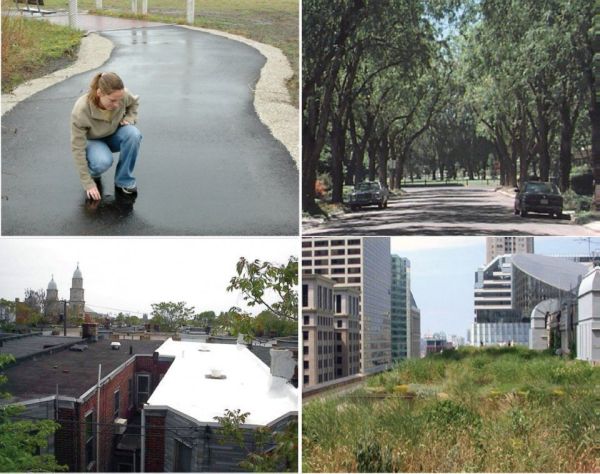
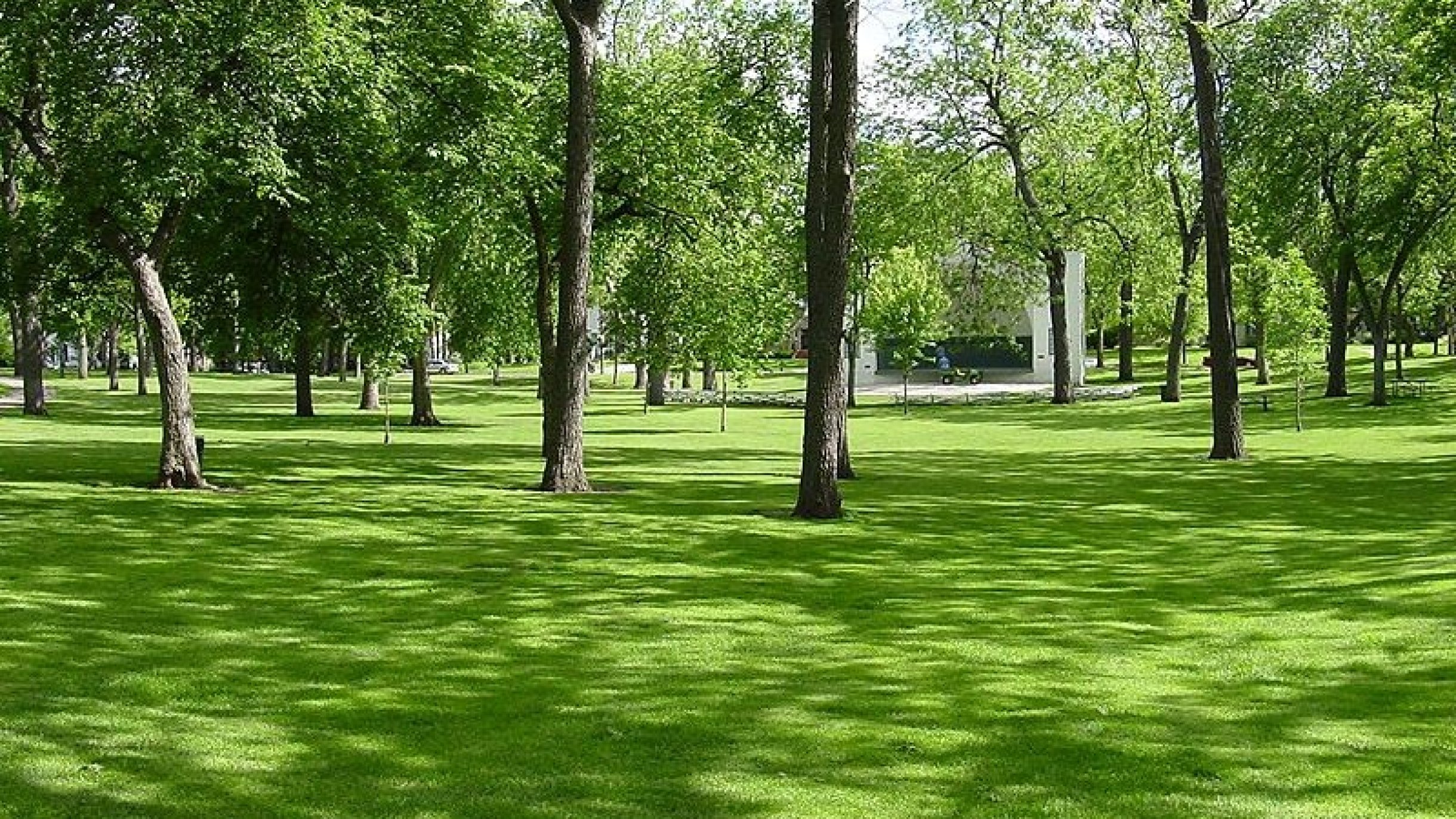
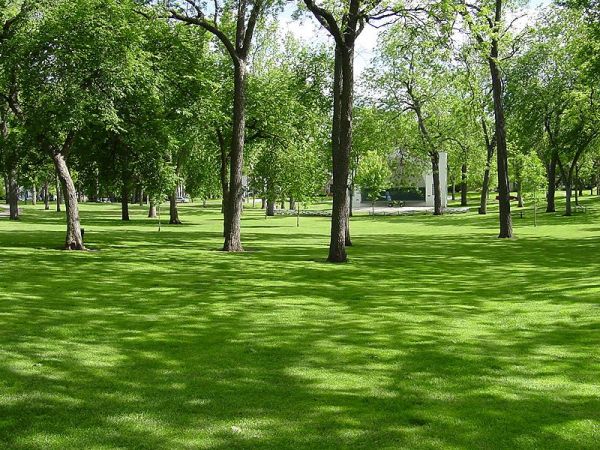
Trees and Vegetation - Increasing tree and vegetation cover lowers surface and air temperatures by providing shade and cooling through evapotranspiration. Trees and vegetation can also reduce stormwater (rain falling on the ground) and protect against erosion.
Green Roofs - Growing a layer of vegetation (plants, shrubs, grasses and/or trees) on a roof reduces temperatures of the roof surface and surrounding air and improves stormwater management. Also called "rooftop gardens" or "eco roofs," green roofs achieve these benefits by providing shade and removing heat from the air through evapotranspiration.
Cool Roofs - Installing a cool roof - one made of materials or coatings that significantly reflect sunlight and heat away from a building - reduces roof temperatures, increases occupant comfort, and lowers energy demand.
Cool Floors - Using paving materials on sidewalks, parking lots and streets that stay cooler than traditional pavements (reflecting more solar energy and improving water evaporation) not only cools the floor surface and surrounding air, but can also reduce stormwater and improve visibility at night.
Smart Growth - These practices cover a range of development and conservation strategies that help protect the natural environment while making our communities more attractive, economically stronger and more livable.
The green contribution to temperature
A natural lawn undoubtedly contributes to maintaining a lower temperature than a synthetic lawn. By practicing the teachings of physics it is possible to make a rough estimate of a contribution of up to around 8â°C thanks to the evapotranspiration which contributes to keeping our air conditioners off!
The answer to this question requires addressing it starting from a surface energy balance approach, in which we consider how the incoming solar energy is divided into various components in the system composed of the natural lawn or synthetic carpet. In other words, we need to compare the cooling capacity—called evapotranspiration in the case of lawn—with that of a synthetic surface which, on the contrary, dissipates solar energy even more in the form of sensible heat.
Below is an overview of the steps to arrive at a simplified estimate:
1. **Surface energy balance:**
The basic equation is:
\[
R_n = H + LE + G
\]
where:
- \(R_n\) is the net absorbed radiation (i.e. the input solar energy minus the reflected one),
- \(H\) is the sensible heat flux (the part of energy that increases the temperature of the air near the surface),
- \(LE\) is the latent heat flux (the energy used to evaporate water, which results in cooling),
- \(G\) is the conductive flux towards the ground.
Intensively cultivated lawn, being capable of evapotranspiration, uses a substantial portion of \(R_n\) for the \(LE\) process, while synthetic turf, which does not evaporate water significantly, channels almost all of \(R_n\) into the sensible flow \(H\).
2. **Calculation of net radiation (\(R_n\)):**
On a sunny day at 30°C the solar irradiance \(I\) can be estimated at around 800–1000 W/m². The energy actually absorbed will depend on the albedo \(\alpha\) of the surface:
\[
R_n = (1 - \alpha) \cdot I
\]
In general, the lawn (often with \(\alpha\) around 0.2–0.25) absorbs a greater fraction than surfaces that instead have "cooling" or reflective materials.
3. **Contribution of evapotranspiration (\(LE\)):**
For a lawn, the cooling due to water evaporation is calculated as:
\[
LE = \lambda \cdot E
\]
where:
- \(\lambda\) is the latent heat of vaporization (approximately 2.45 × 10ⶠJ/kg at temperatures around 30°C),
- \(E\) is the evapotranspiration rate (in kg/m²·s).
In summary, the greater the evapotranspiration, the greater the flow \(LE\) which subtracts energy from the system, lowering the surface temperature.
4. **Relationship between sensible flow and temperature difference:**
The sensible heat flux \(H\) can be expressed as:
\[
H = \rho_a\, c_p\, \frac{(T_{\text{surface}} - T_{\text{air}})}{r_a}
\]
where:
- \(\rho_a\) is the density of the air (about 1.2 kg/m³),
- \(c_p\) is the specific heat of the air (approximately 1005 J/kg·K),
- \(r_a\) is the aerodynamic drag (in s/m),
- \(T_{\text{surface}}\) and \(T_{\text{air}}\) are the surface and air temperatures, respectively.
In a synthetic turf, almost all of the \(R_n\) energy will go into \(H\) (since \(LE\) is negligible), leading to significantly higher surface temperatures than in natural turf.
5. **Simplified estimate of temperature reduction:**
If we wanted to isolate the cooling effect due to the evapotranspiration of the lawn, we can approximate the reduction in temperature (\(\Delta T\)) due to \(LE\) as:
\[
\Delta T \approx \frac{LE \cdot r_a}{\rho_a \, c_p}
\]
For example, if in a specific situation the lawn generates a latent flow \(LE\) equal to approximately 200 W/m² and assuming an aerodynamic resistance \(r_a\) of approximately 50 s/m, we have:
\[
\Delta T \approx \frac{200\, \mathrm{W/m^2} \times 50\, \mathrm{s/m}}{1.2\, \mathrm{kg/m^3} \times 1005\, \mathrm{J/(kg\cdot K)}} \approx 8.3\, \mathrm{°C}
\]
This estimate indicates how, in ideal and simplified conditions, the lawn could be up to approximately 8 °C cooler than a synthetic surface in which this effect is not present.
It is important to highlight that this calculation is highly simplified: in reality, the energy balance also depends on further factors such as the specific characteristics of the soil, the hourly radiation regime, the effective rate of evapotranspiration which in turn depends on the availability of water, the phenological state of the plant, and also on local microclimates. Furthermore, the synthetic carpet may have its own particular reflective or insulating properties which affect its surface temperature.
So, to calculate the "contribution" to the reduction in temperature of a natural lawn compared to a synthetic carpet, we start from the measurement (or estimate) of:
- The incident solar radiation and its conversion into net radiation (taking into account the albedo),
- The capacity of the lawn to evaporate water (measured in terms of \(E\) or deduced experimentally),
- The properties of the surrounding air (density, specific heat, aerodynamic resistance).
Finally, we apply the equation that relates the latent flow to the temperature difference that would otherwise have been recorded if all the energy had ended up in sensible heat.
This energy analysis is an integral part of investigations into the mitigation of heat islands in urban areas, precisely because plant surfaces, thanks to evapotranspiration, play a fundamental role in cooling the air compared to artificial surfaces. If you wish to delve deeper into the topic, we could examine in detail how the parameters vary according to different atmospheric conditions or how experimental studies in this area are conducted.
Related topics
Environmental benefits
6 points of merit on our fields
Heat islands
Mitigation and green contribution


Foliar fertilization
What it is, design and application
Write to Us
For any kind of request write to us.