Ecology and convenience
The POWERgrass hybrid system is in line with the "Do No Significant Harm" (DNSH) principle for the environment, which is fundamental for accessing PNRR funding
It also offers the opportunity to create an innovative and effective field to satisfy all the six objectives of the Recovery and Resilience Facility (RRF) because: a) it promotes the ecological transition by spreading notions of ecological maintenance of sports fields which can also be extended to the agricultural sector, b) it monitors growth conditions and remotely manages the systems installed using digital technology, c) it strengthens the growth of SMEs that invest in innovation and training, d) it offers opportunities for international social cohesion, organizing tournaments with PRO teams, e) has a positive impact on health and the environment and is resilient to climate change, and f) promotes new skills that stimulate the critical, civic and collaborative sense of young operators. The POWERgrass hybrid system with constant but reduced maintenance can last up to 30 years and is reusable at the end of its life cycle.

Without a doubt, synthetic grass increases the number of hours of game use and simplifies maintenance, but it produces a negative environmental impact, which is deleterious in the absence of controls regarding lack of maintenance, which is even difficult to verify without constant monitoring because as long as the grass is green everything seems to be fine. Furthermore, the management of waste from synthetic fields, at the end of their life cycle, does nothing but stimulate the underworld that speculates during the disposal phase.
Meanwhile, the market is moving towards more environmentally friendly synthetic turf systems, because concerns about the environmental impact of microplastics have prompted extensive research that has produced a report by the European Chemical Agency (ECHA) on how to reduce emissions in the environment. The report estimates that around 50,000 tonnes of microplastics are used in the EU/EEA each year and that around 42,000 tonnes are released into the environment (including emissions from infill material used for artificial grass, which could reach 16,000 tonnes per year).
In January 2019, ECHA proposed to the European Commission a total ban on rubber infills in artificial turf pitches on the EU/EEA market to prevent or reduce their release into the environment. It is estimated that this solution could reduce emissions by at least 70% and prevent the release of 500,000 tons of microplastics in the 20 years following its introduction.
The reform of the REACH regulation provides for a ban on the use of microplastics, within 6 years of its entry into force. At the same time, governments offer non-repayable incentives or green credits to those who today are moving towards systems and business models following the principles of the circular economy in a sustainable and effective way. It is necessary to trace an ecological footprint that takes into account the entire life cycle of the system through a holistic design that measures the impact at each phase: a) production and installation, b) the period of use and maintenance and c) the processes implemented by who, what, why, when and where the waste is intended to be disposed of. For each project, the costs associated with maintenance must also be developed and financed because it is known that ordinary maintenance reduces extraordinary maintenance. The consumption of natural resources, the risks associated with bad weather with a minimum thirty-year climate change scenario and disposal or recovery at the end of life cycle must be taken into account with the strategic objective of producing employment in circular processes.
Therefore arises the need for a hybrid turf that has a neutral or positive environmental impact which, at the same time, offers a resistant field and reduces maintenance, to also provide economic interest to investors. According to our studies, also confirmed by the independent studies of Sport England, POWERgrass is an effective system capable of remedying these problems, offering high usability with reduced maintenance.
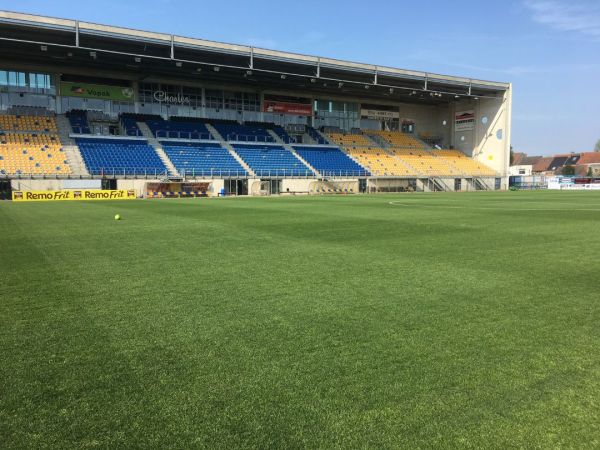
The POWERgrass hybrid (natural and synthetic) grass system is an effective alternative to entirely synthetic grass systems that combines playing safety, high usability and positive environmental impact, at low maintenance costs.
Dr. Niko Sarris
Strategic planning must prevent waste production
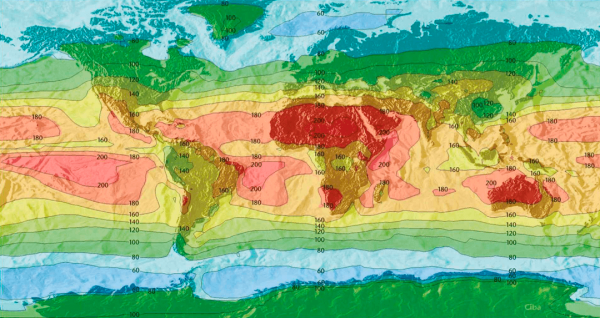
Despite the development of higher quality products in recent years, in the best case scenario a synthetic grass field does not exceed 10 years of life. Synthetic yarns exposed to the sun deteriorate by more than 50% in approximately 3.5-4.5 years, which refers to reaching 650 kLy (kilo Langley) of exposure to solar radiation.
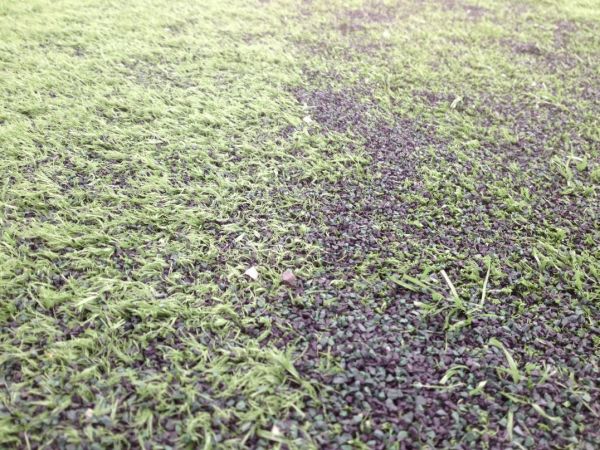
At the same time, in the latest generation synthetic turf systems, organic infill is promoted to simulate natural soil and keep the surface fresh, but water evaporation is still much higher than on natural turf. The low density of the organic components makes them easily removed by wind and rainwater so it is necessary to replenish the infill material every year to maintain the performance characteristics of the system and prolong its life.
Disposing of the old synthetic system in an authorized landfill costs €0.45/kg because plastic is a non-hazardous special waste and costs are expected to increase in the future due to the decrease in landfills. Furthermore, the costs of removal, separation of the various plastic components and transport must be added, not to mention that the disposal of old fields in landfill is a serious and poorly managed problem because it often escapes controls.
POWERgrass hybrid carpet does not contain contaminants
Sunlight (radiation) associated with intensive use especially on the hottest days (above 30°C) are the main factors that lead to the degradation of synthetic fiber polymers. Typically the harmful radiation is the UV component (290-300 nm). The absorption of UV light causes breaking of C-H and C-C bonds, formation of free radicals with consequent drop in molecular weight of the polymer, absorption of oxygen and appearance of new chemical groups (coloration, hydrophilicity). In fluoropolymers the C-F bond is more stable and does not break under UV light. Therefore, the higher the fluorine content of the polymer, the better its stability to external conditions. However, in recent decades, concerns about the health of fluorochemicals have forced the industry to eliminate them from use. The large fine from the EPA (Environmental Protection Agency) to Dupond in 2005 is impressive.
In the hybrid turf used in the POWERgrass system there are no fluorochemicals also because they are protected by the natural grass and as long as it is constantly maintained, the synthetic fibers are not exposed to the sun therefore they do not undergo aging due to the photo-oxidation of the UV of the sun.
The POWERgrass hybrid turf offers a positive environmental impact by encouraging the growth of natural grass
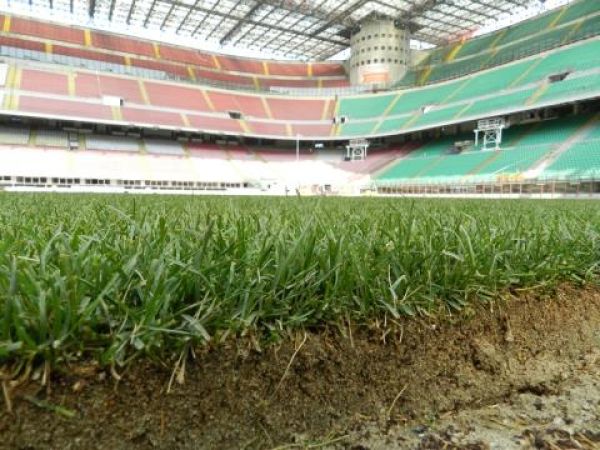
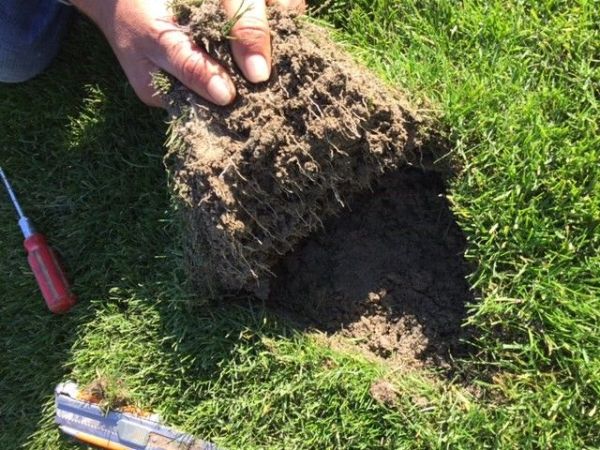
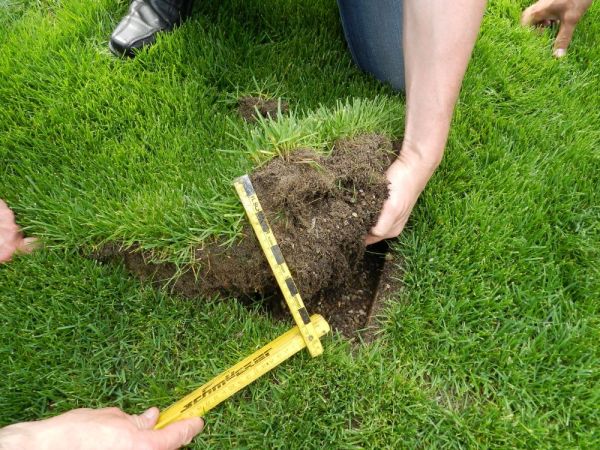
The natural grass is the predominant part, 97% in POWERgrass while the synthetic carpet is almost imperceptible to the athlete. The natural lawn helps prevent soil erosion, lower the temperature and purify the air from fine dust, filter rainwater, capture carbon dioxide CO2 and produce oxygen O2. By sequestering carbon in the soil the system offers a significantpositive environmental impactbecause lawns are known to be able to sequester anywhere from 25.4 to 204.3 g C/m2/year (Zirkle et al., 2011); POWERgrass optimizing the photosynthesis potential with the teachings of regenerative agriculture sequesters more carbon in the soil. Our goal is that, within two years of installation, each field benefits from its own soil biology and fertilizer inputs can be reduced.
The natural turf retains rainwater in the substrate thanks to the roots and associated microorganisms, slowing runoff into the drainage system. The lawn returns humidity to the air through the transpiration of the leaves, promoting the natural water cycle. The nutrients are retained by the vegetation and the rich bacterial flora associated with it, also thanks to foliar applications which are more effective and prevent run-off and pollution of the aquifers. When the plant substrate is saturated with rainwater, some reaches the drainage trenches and recharges the aquifers with clean, naturally filtered water. Only excess water enters the micro-perforated pipes and flows into the sewer system, thus avoiding accumulation with waste water and the risk of flooding.
The synthetic support prevents compaction of the underlying substrate, retains humidity and promotes gas exchange, essential for roots and microorganisms. For this reason, the synthetic support creates the ideal habitat for root development, offering protection from heat, cold, insects and disease. To maintain optimal growing conditions, POWERgrass requires mechanical raking and surface aeration with the spike roller every 30 hours of use and, generally, two deep aerations to facilitate gas exchange in the hot/humid periods of early summer and cold/humid periods of late autumn. Associated with the natural cork integrated into the upper substrate, the system remains soft for longer without the need for frequent maintenance interventions.
The ZOEsand soil improver offers a buffer effect because it absorbs the water that enters the rhizosphere, preserving playing conditions even in case of rain; it absorbs excess nutrients and exchanges them with the bacterial flora to transfer them to the plants when they are needed, promoting more regular growth. Careful management of irrigation water allows you to save the most precious resource and strengthen the natural turf, which thus becomes more resistant to climate change.
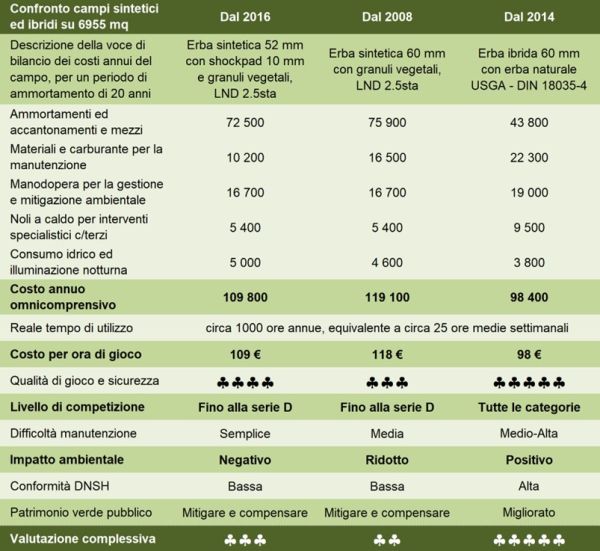
The direct cost is equivalent to a synthetic field but the hydraulic system is effective and water for irrigation is saved
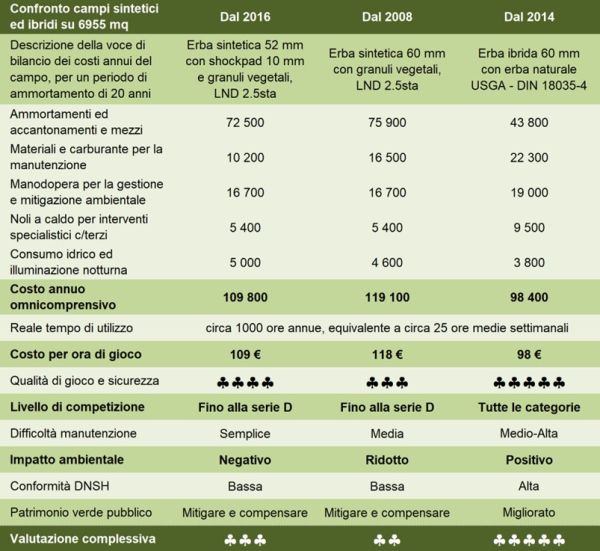
Considering the overall cost of depreciation and provision for the extraordinary maintenance to periodically redo a playing field - every 10 years for a synthetic one (peremptory) and 20 years for a hybrid (non-mandatory) - and the cost for ordinary maintenance we have a very similar annual incidence.
In POWERgrass, ordinary maintenance must be constant but is reduced compared to a natural field because holes do not form but is higher than a synthetic field because it requires fertilizers, seeds, paint for the lines and the purchase of more professional equipment. However, compared to an initial investment for the purchase of equipment, which can be part of the investment plan, if maintenance is carried out regularly, extraordinary interventions can be avoidedfor the replenishment of the infill of a synthetic field or for the replacement of the sod of a natural field.
The amortization plan of a synthetic pitch lasts approximately 10 years in northern Italy and 8 years in the south while a hybrid pitch, well designed and maintained, offers the possibility of amortising the investment in 20 years. In the case of long-term financing, the remaining works (lighting, fencing, changing rooms, stands) also benefit from a longer repayment plan.
Natural grass facilitates the hydraulic governance of the territory because it is able to absorb a high quantity of water in the sandy substrate following heavy rainfall and retain the free water suspended between the mesopores of the substrate, thanks to the capillary forces until the substrate is completely saturated. Only when the forces of gravity prevail over the capillary forces in the substrate, the excess water is transferred into the drainage layers, thus mitigating the speed of flow of rainwater towards the drains. We recommend the installation of large rainwater storage tanks which, once filtered and purified by the natural grass, can be used again for irrigation, avoiding taking drinking water from the groundwater.
Indirect savings for a sustainable playing field that is easy to control
If we take into account the indirect savings on environmental impact as well as the risks from bad weather, then the POWERgrass hybrid system always wins because preserving health and preventing damage is the best insurance policy we can do.
For example, in a synthetic pitch, frequent brushing of the rubber infill of a synthetic pitch is necessary to lift the fibers and redistribute the rubber granules but favors the production of fine dust and microplastics. By investing in the hybrid pitch, our health also benefits because instead of brushing the synthetic, the natural grass is cut, releasing the pleasant scent of freshly cut grass.
The natural grass in the POWERgrass hybrid system prevents the risk of soil erosion due to sudden bad weather that causes flooding, because its roots stabilize the sandy infill together with the hybrid layer and the subfloor. On the contrary, when a synthetic pitch floods, the damage can be extensive because, depending on the type of infill, it can take away a good part of the water that flows over the surface and, in some cases, it can even lift the surface by bending it which makes any repair complicated and expensive.
Maintenance of POWERgrass is simple to carry out and check because the grass reacts immediately. This therefore requires seriousness in field management and maintenance and offers the possibility of providing a positive environmental certification throughout the management period. Given this commitment, the manager does not run the risk of having to replace the field at the end of management, as many agreements require, and much less does the Municipality find itself in the difficulty of having to manage an unusable field because the system does not require peremptory replacement. In fact, sowing and some fertilizing is enough to regenerate the field and leave it still usable and better than before.
Attachments
Insights



Write to Us
For any kind of request write to us.