Type of playgrounds
Natural, reinforced, natural hybrid, synthetic hybrid or synthetic.
Synthesis
 In search of increasingly high-performance surfaces, in times when stadiums are used several times a week and offer difficult conditions for the growth of natural grass, several innovations have arrived on the market. In addition to traditional natural grass and the established third generation of artificial grass, a new generation of playing surfaces is growing in popularity: what are often simply called hybrid systems actually include various combinations of materials and construction types. For this reason, following the document produced by FIFA, we aim to offer an overview of the various types of sports surfaces used in football, with some guidelines on the technical aspects and performance also in relation to the innovative POWERgrass hybrid system.
The typology of playing fields according to FIFA
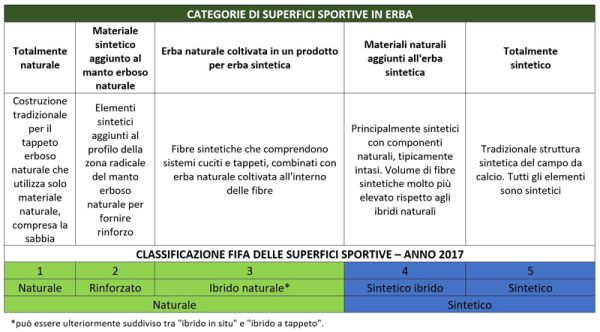
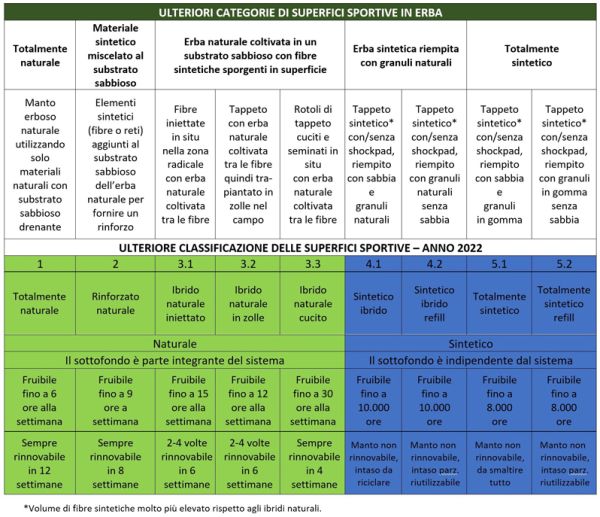
Since many different terms are used to qualify surfaces as "hybrid", "reinforced", "mixed", the following table aims to provide a clearer overview of the different categories, placing them in the natural-synthetic continuum. The table should be understood as a generalization of current products. As innovations and technologies evolve, classifications may need to be updated. In 2017, FIFA proposed the following classification:
The differentiation is made based on the organic/inorganic nature of the materials used, the impact of the materials on the final product and the typical maintenance required for each category. Natural grass is a living organism that can grow and regenerate, while synthetic grass does not.
- The category "natural turf" includes all cultivated or laid grass surfaces that do not include other materials.
- The "reinforced surfaces" include additional support in the construction of the root zone, with the aim of strengthening the hold of the grass. For the user, the surface does not look any different, as it is in fact just natural grass.
- "Hybrid natural surfaces" are the ones most commonly referred to when the term "hybrid" is used. These are natural surfaces grown within a base of synthetic fibres. Synthetic fibers are visible, but normally make up less than 5% of the total grass cover, which is why these surfaces are classified as "natural".
- "Hybrid synthetic surfaces" are based on artificial turf with sand, but can use natural organic materials such as so-called performance infill (typically instead of rubber infill). This category is considered a synthetic turf as it essentially requires the maintenance of an artificial turf field.
- The "synthetic surfaces" are made up of artificial materials (produced or manufactured by man), generally an artificial grass carpet, a sand infill and a rubber infill with the possible addition of an elastic shockproof underlay.
Please note:the hybrid grass systems, for homologation purposes, belong to the category of natural grass playing field.
The substantial differences between hybrid systems
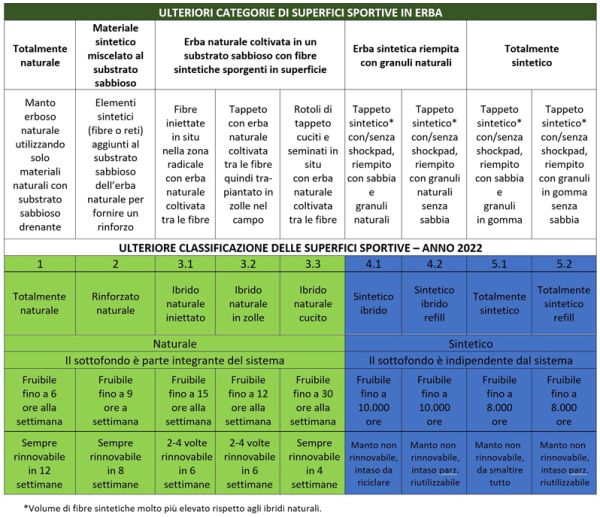
With the development of innovative technologies, a further classification is possible because the choice between the various hybrid systems and the installation method can significantly influence the usability of the field during the week, the construction and maintenance costs and the possibility of renewing the system several times, therefore also its duration. For example, between an in-situ injected vertical hybrid system, a sod transplanted horizontal hybrid system, and an in-situ installed horizontal hybrid system, there are so many variables that they can easily constitute three subtypes of natural hybrid fields.
3.1 In the case of the natural vertical hybrid system, there is no support for the roots to cling to. The system requires a special machine for installation and the tightness of the fibers to the ground depends on the consistency of the sand layer and the working depth. The fibers are usually planted 18cm deep and form a very solid surface. During play, fewer holes form on the surface, but the ground tends to harden quickly. Post-match resetting and frequent punching is still required to maintain surface softness in the optimal range of 65-85g with the Clegg hammer. The difference between one vertical system and another is given by the quality of the fibers and their number per square meter which is usually around 2500 points per square meter.
3.2 In the case of the natural horizontal hybrid system, we mean all types made with artificial carpets with an open horizontal support, easily penetrable by the roots that anchor themselves to it. The fibers must be welded to the horizontal support in the factory with a force greater than 30 N. The difference between one system and another concerns the type of support, the quality of the fibers and the number per square meter, which must not exceed 5% of the surface, to leave ample space for the natural grass. We won't go into technical details between one system and another, but we can make a big distinction for those transplanted into the field in large clods. This type of plant necessarily involves a cultivation period in the nursery of between three and six months. Often, hybrid sod is grown far from the final installation field and this requires adaptation to a different climate. In any case, special machinery, numerous vehicles and punctual organization are required for the collection, transport and laying of the hybrid sod. Additionally, transplanting itself is a great stress to the lawn, creating more thatch, while differences between sod joints often require reseeding and sanding which tends to bury the synthetic fibers. In the natural grass renewal phase (necessary at most every 3 years) the operation is complicated, if not impossible, to remove the natural grass without lifting the artificial grass or damaging the synthetic fibers.
3.3 In the case of the natural horizontal hybrid system with in-situ installation, however, these problems arise less because the open-backed artificial grass rolls are stitched together. Many believe that the lawn needs to grow for at least 6 months to reach the right maturity. However, thanks to an optimized cultivation method, it is possible to provide a ready-to-use horizontal hybrid turf within 4 weeks of sowing, a period consistent with the summer break in play. In the case of intensively used fields, by favoring systems with a greater number of fibres, it is possible to have a field that is always playable even during the winter, and then plan reseeding in the ideal growing season. Sewing the rolls together allows you to easily renew the system every 2 or 3 years without damaging the fibers or lifting the artificial grass, thus providing a pitch that can last over 20 years like the POWERgrass pitch.
4.1 and 4.2 In the case of synthetic hybrid and refill synthetic hybrid systems, it should be clarified that in neither case do we have natural grass, except when weeds grow. The main difference between one and the other is that the first has two types of infill: the stabilizing infill (dried sand) and the infill with natural organic grains. Both blockages must be removed when replacing the system at the end of its life cycle and possibly recycled for other uses. The synthetic hybrid refill system, however, does not use sand to stabilize the artificial surface, because the performance infill is heavy enough to perform both functions. In this case, the infill can be partially reworked, cleaned and reused at the end of the artificial grass's life cycle.
Attachments
Insights
Write to Us
For any kind of request write to us.