Specifications
If it were that easy to design an effective hybrid system, someone would have succeeded 30 years ago.
If it were so easy to design an effective hybrid system, someone would have succeeded 30 years ago. It's about combining two opposing worlds, natural and synthetic, with often conflicting interests and a different approach. The choice is more complex than usual because you have to combine different characteristics and you can't help but study the details to understand which are the essential ones.
The difference is in the details
When you go to buy a car to cover many kilometres, you pay attention to the details in order to have a comfortable journey and to save money over its useful life; you pay the same attention when you buy a house to live in, therefore with this attention you need to plan all the important investments whether they are for private or public use.
Each project must be able to provide answers regarding:
- performance and safety for athletes,
- usability over the entire day according to objective needs (avoiding the banal 24/7),
- duration over time in relation to average annual use,
- cost of management during the period of use and maintenance and availability of the necessary resources,
- minimum guarantee with no strings attached,
- environmental impact during installation and during its useful life
- hydraulic management, and mitigation of risks from bad weather,
- the costs for the disposal and the restoration of the original state at the end of management.
Through these answers a well-structured project allows you to select the best system to satisfy the requirements contextualized in the territory.
A good hybrid must also prove its effectiveness when subjected to intensive use because it is not enough to have a carpet with holes for it to really work.
Finally, an expert installer and a diligent manager must be selected for the period of use and maintenance so that the system is installed and maintained correctly, throughout its life cycle. Maintenance of the POWERgrass is not easy to carry out without training but it is simple to learn if the operator is supported by an expert technician. However, it must be constant because the better you do the ordinary one, the less you need the extraordinary one.
The drainage system
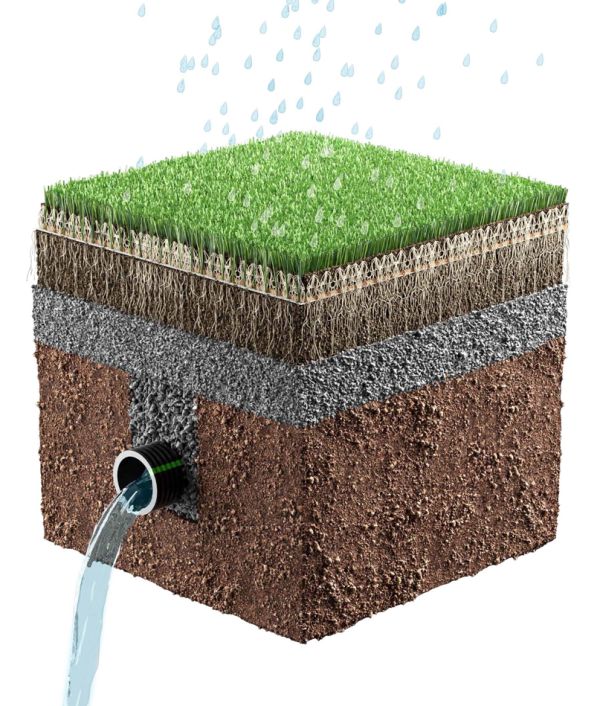
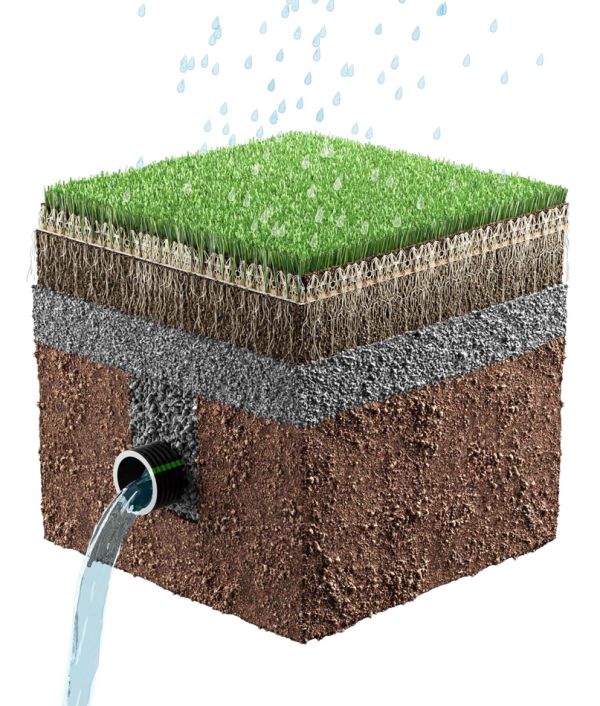
The drainage system must remove excess rainwater and disperse much of it into the ground below to avoid burdening the flow rate of the sewer system. In some cases the roots reach the drainage layer and are able to absorb the water in the underlying soil, thus saving the most precious resource.
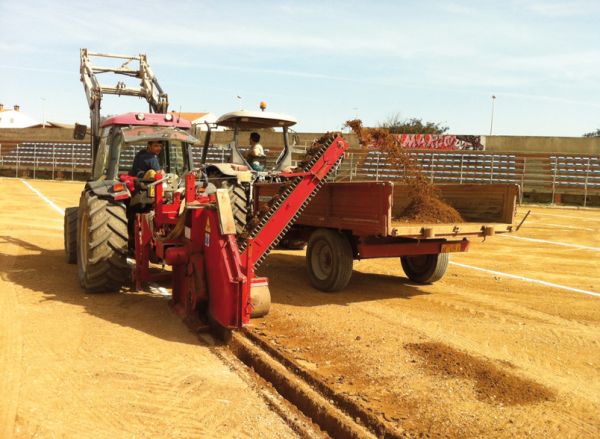
Creating an effective drainage system is very easy. The primary drainage is carried out after having leveled and settled the starting surface of the fund, with two or four pitches. Then dig up to 50 cm deep and approximately 50 cm wide, along the entire perimeter of the area to be drained. Having to disperse the water along the excavation, it is sufficient to maintain the same excavation height, thus also slowing down the flow towards the sewer. Subsequently, a 160 mm corrugated drainage pipe is laid and covered with crushed stone up to the surface. The discharge of excess water can be carried out directly into the aquifer through a leaky well or directly into the white water drains. POWERgrass recommends the installation of large storage tanks to contain the requirement of at least 5-6 irrigation cycles to save the most precious resource.
The inspection wells located at the intersection points of the diagonal pipes with the perimeter ones facilitate periodic maintenance cleaning. The channels are not necessary for drainage, as the draining bottom absorbs all the water that is dispersed or removes it through the pipes, but if the area is subject to heavy rainfall or is subject to heavy snowfall, the channel collects the water that flows on the surface.
Next you need to create the secondary drainage, then divide the field into the two axes every 10 meters or so and trace the first point of the vertical axis diagonally with the first point of the horizontal axis and so on until the end. Diagonal drainage can be achieved with a mini-excavator or catenaries with a section varying from 12 to 30 cm and up to 35 cm deep. Subsequently, a 90 mm corrugated drainage pipe is laid which is covered with crushed stone up to the surface.
Based on the type of surface (whether it is filtering or not), the rainfall in the area (light, slow rain or frequent heavy showers) and the budget available, you must choose between a) a complete layer of mill stone over the entire surface or b) additional microdrains every 25-50 cm dug with special equipment and filled with coarse and very coarse sand.
The irrigation system
The watering system with 24 medium-range retractable sprinklers is designed to distribute water more uniformly than long-range ones and better rationalize water consumption.
In the upper part of the sprinkler there must be a small soft rubber cup to contain a small clod of natural grass installed at the same level as the pitch. In fact, when the system is turned off it is difficult to locate the sprinklers in the ground.
The sprinklers can be connected to a solenoid valve individually or to two sprinklers in the same valve. In the second case it is necessary to take into account a) connecting sprinklers with a homogeneous range of action; for example in a football field there are normally sprinklers with three different ranges of action at 90°, 180° or 360° and b) combine sprinklers possibly from non-adjacent areas since a good rule is to alternate the irrigation zones to ensure that the water from the previous area/sprinkler penetrates the ground.
Programming takes place with a control unit, starting 1, 2 or 4 sprinklers together based on the type of system, flow rate and operating pressure of the water. In hot weather, it is recommended to install a pump that provides enough water and pressure for the operation of 4 sprinklers, thus allowing you to supply the necessary water in a short time.
The POWERgrass hybrid turf system consists of:
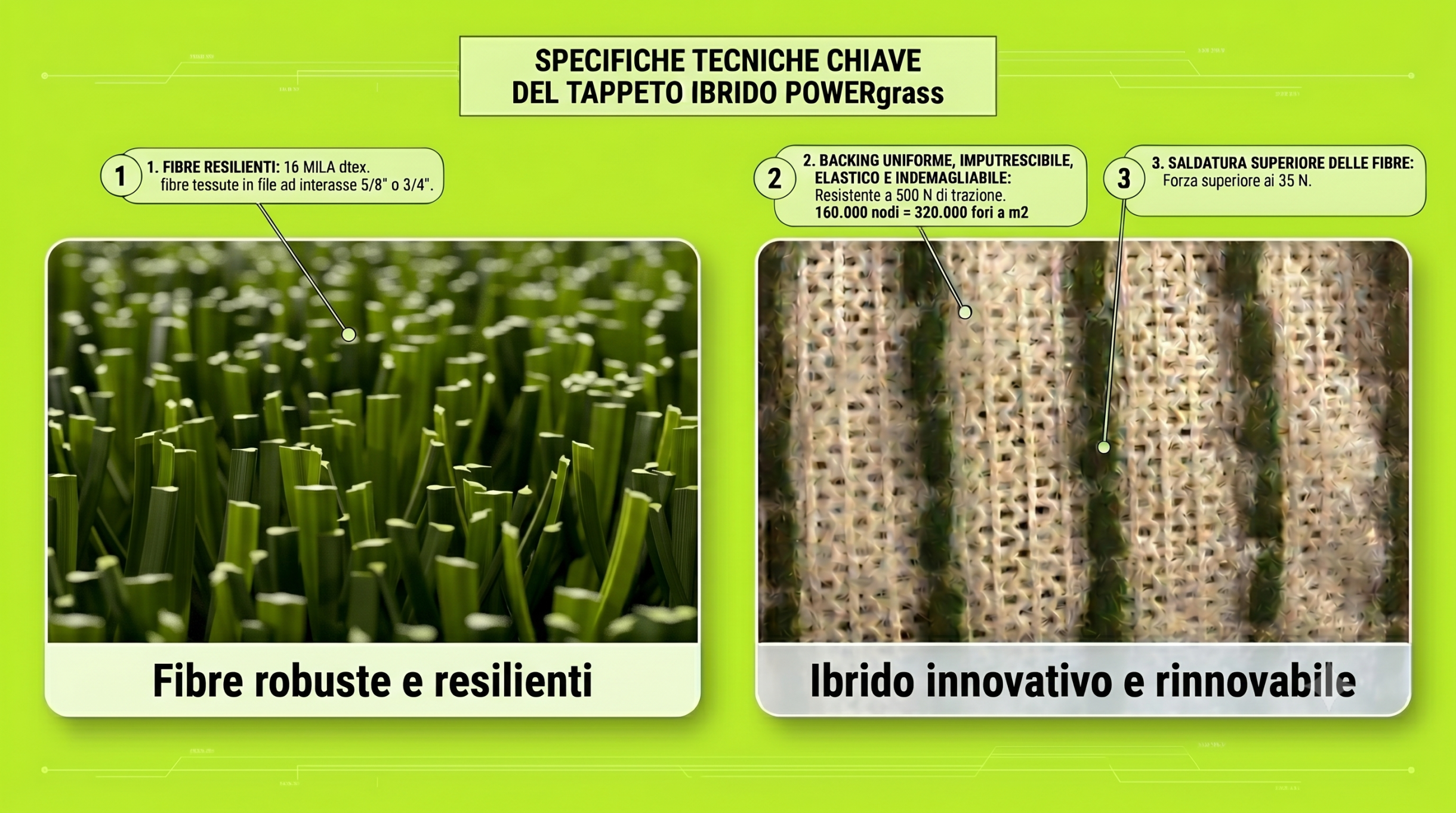
A. a hybrid blanket with 60 mm high fibres, arranged in at least 6000 tufts of 12 threads ≈ 72000 monofilaments per m2. The tufts are fixed to the support with tear resistance ≥30 N using LC-HM technology without obstructing its permeability and softness. The hybrid surface is bendable 180° at each intersection between the nodes to remain elastic to the pressure of the players. The backing and the seams of the rolls stitched together must be strong withtear strength ≥500 N,to facilitate installation and durability.
- The fibers are of two shapes and colours, with 6 strong and soft mono-extruded filaments, with a minimum section of 350 microns to increase wear resistance. The resilience of the filaments is ≥2.00 cN (calculated at 300 cycles with the Favimat R Textechno method).
- The primary support is made of a rot-proof mesh, woven on a Raschel loom, which gives a three-dimensional shape with high porosity for approximately 160,000 voids/m2 of irregular shape. The mesh allows air circulation and the passage of roots and at the same time limits the migration of sand which would otherwise block the voids causing hardening. The net is warp-knit to maintain its structure after multiple holes to aerate the underlying rhizosphere with 8 mm diameter tips.
- The secondary support consists of a thermoplastic glue spread in line, exclusively on the lower part of the fiber tufts, just before compression with the heated roller to seal the fibers to the mesh, without blocking the space between the rows of tufts. It also includes a light geo-textile which provides an insulating effect to mitigate heat and frost stress.
B. a substrate complies with USGA standards based on silica sand mixed by volume at 7-10% with a zeolite-based mineral soil improver and bovine compost stabilized in worm farming. After stitching the rolls, the hybrid surface is filled and raked with cork grains with a diameter of 0.5-2.5 mm and weighing no more than 130 kg/m³ for approximately 7 mm, then filled and raked with the same sand mixture gradually, until the formation of a uniform layer of 35 mm, to allow the best interaction of the athlete's cleat with the surface.
C. greening with sowing on site,fertilization and management of all ordinary maintenance activities until delivery for use of the field. The choice of essences depends on the climate and the sowing season, the fertilizations must favor rapid establishment with a natural grass cover of no less than 95%. It is therefore imperative to develop a detailed plan of the activities implemented, with the list of machinery and products available: seeds, growth-promoting fertilizers, biological inoculants, etc.

Insights
The perfect FIFA 2026 pitch
In search of excellence in the perfect field, POWERgrass could not be missing! And now with the first results they confirm...
Show moreThe perfect FIFA 2026 pitch
Sport and Suburbs 2026
It is aimed at municipalities with over 5000 inhabitants, also in associated form, with a focus on the recovery of...
Show more