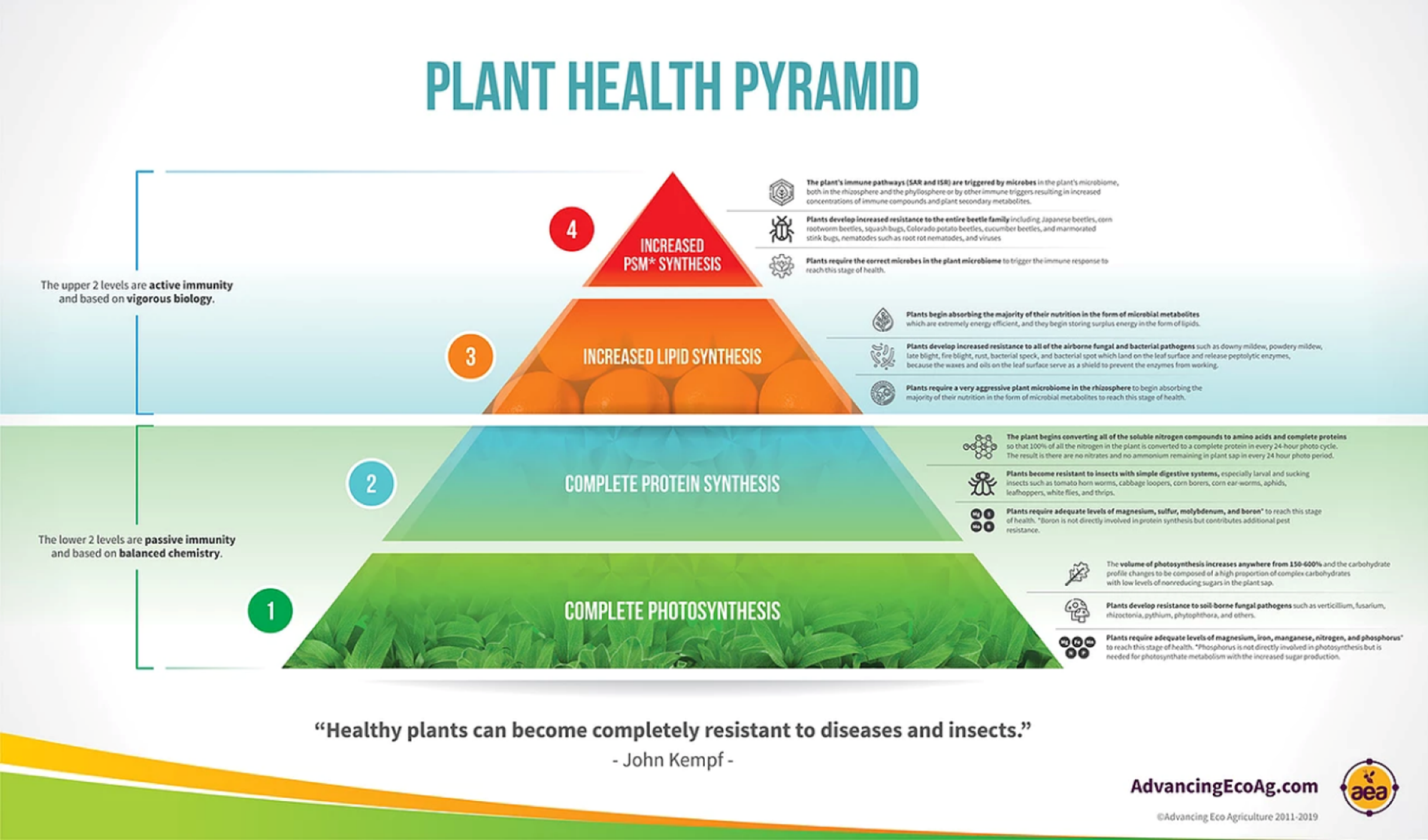
The plant health pyramid
The case of John Kempf who described to us how to regenerate and care for our plants
It's really true, you have to make mistakes and hit rock bottom to find enlightenment and this is the case of John Kempf who, thanks to his passion and altruism, has made accessible the information we need to properly feed plants in a productive and ecological way.
The teachings of John Kempf, the founder of the AEA, were an enlightening beacon
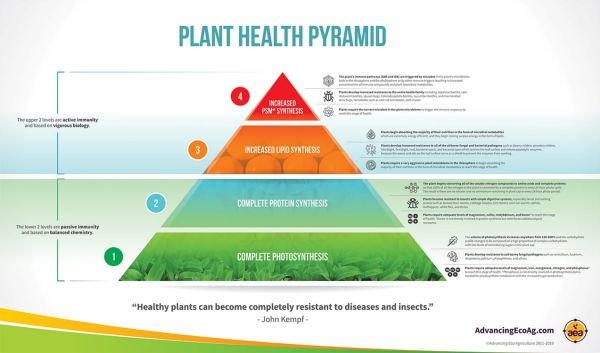
John Kempf was one of the pioneers to spread the regenerative agriculture method and is the founder of AEA (Advancing Eco Agriculture). John claims that“healthy plants can become completely resistant to disease and insects.” In his videos he explains that apparently healthy plants can be divided into four levels of health in the plant health pyramid and what the results are obtained at each level reached. It also explains the role of biological activity in the soil and the strategies to progressively achieve a higher level of health, accompanying the technician on his journey with numerous other videos with in-depth information.
The primary objective is to optimize production, drastically reduce the use of pesticides and herbicides and synthetic fertilizers. This is possible through the balanced nourishment of the plants with organo-mineral products that maintain a balanced symbiosis of mutual benefits between the plants and the microorganisms capable of building themselves the ideal habitat for growth. The measurement tools available to us today allow us to understand with a good approximation what is happening in the plant. In the past, the agronomist was forced to rely on traditional water and soil analyzes to understand how to make an approximate fertilization program, based on numbers and often very complex and controversial bibliography. This is because it is known that chemical reactions in the soil depend on many factors and the expected results can vary greatly according to a whole series of variables, which are as complex as nature itself. Today, technology offers us the possibility of understanding what happens in a very short time, analyzing the plant sap, which provides rather precise indications on the nutritional balance in the various phases of plant growth.
Fertilizations and the virtuous mechanism of balance
The modern fertilization plan therefore must not aim to enrich the soil with mineral nutrients but to nourish the plant according to its needs and to encourage the development of rich populations of bacteria and fungi useful for the mineralization of nutrients into organic forms, more easily assimilated by plants. This promotes a symbiosis between plants with bacteria and fungi in the soil, exploiting the potential of photosynthesis and the nutrients produced by microbiological activity in the soil.
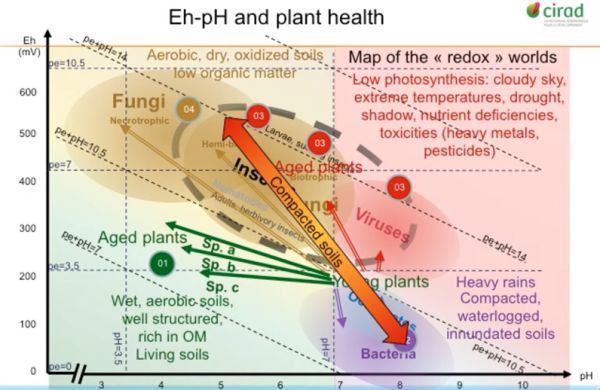
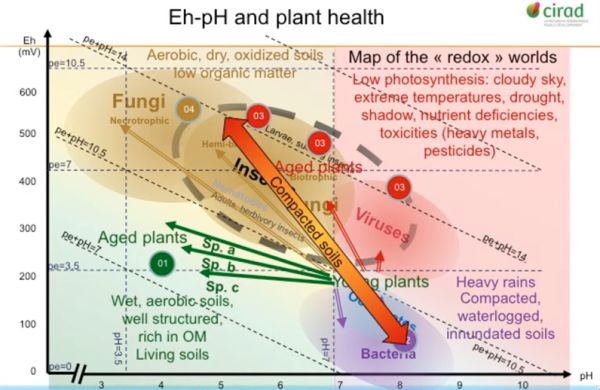
The virtuous mechanism is generated when plants provide useful bacteria and fungi with the soluble carbon they need while they take nutritional minerals from the soil and the atmosphere and metabolise them during their life cycle to give them to the plants. Bacteria and fungi have a very short life cycle therefore, when they die, they release nutrients in the form of organic secretions and amino acids which are therefore more assimilable by plants, which do not have to consume energy compared to direct nourishment in mineral form. The ideal conditions for growth and resistance against parasites and diseases, according to scientists, occurs in a certain habitat of eH and pH that plants are able to modify. In this context, the agronomist's work consists in understanding how climatic variations can influence and using the nourishment, irrigation and drainage systems that he can have to alleviate biotic and abiotic stresses on the plant.
By optimizing the nutritional balance, plants become more resistant to common diseases and less appetizing to insects which, as is known, feed on plant residues, that is, everything that is unhealthy and therefore easily assimilated by their simple digestive system. By progressively improving the health of plants, they increase their own natural defenses and become immune to diseasesand difficult for insects to digesttherefore they avoid them. This allows us to drastically reduce the use of pesticides which often have a devastating role in the biological activity in the soil and in our health.
Analysis of plant sap
Today it is possible to quickly know the health status of the plant through the analysis of plant sap which provides information on the actual absorption of nutrients by the plant. This reveals important information about the health of the plant. Optimal and balanced absorption of nutrients has a positive effect on the natural disease resistance of the plant and, for example, on the quality, consistency and shelf life of the fruit.

Related topics


Environmental benefits
6 points of merit on our fields

Heat islands
Mitigation and green contribution

Foliar fertilization
What it is, design and application
Write to Us
For any kind of request write to us.