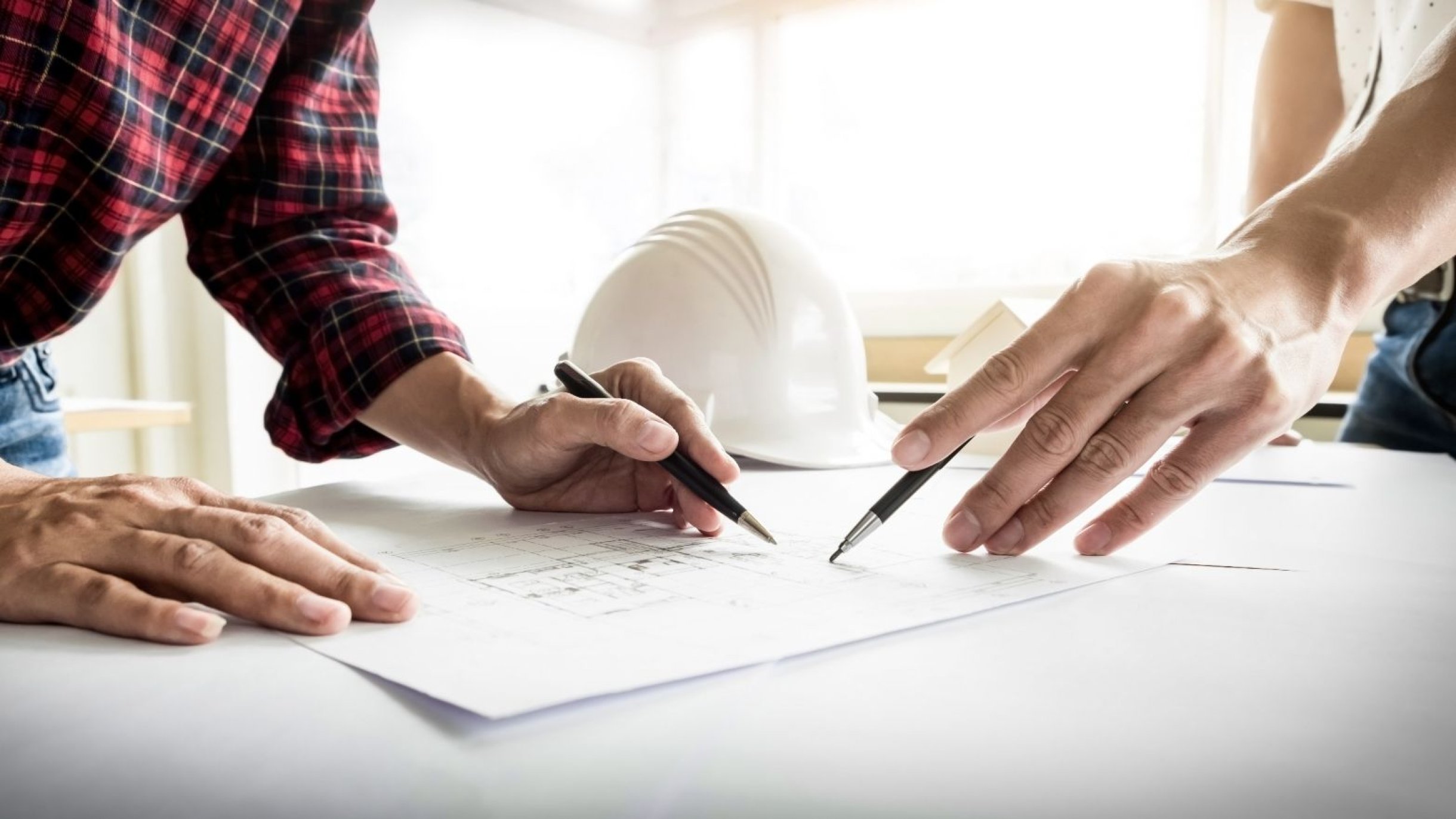
Free design support
30 years of research, development and experience in grass playing fields for sports use!
30 years of research, development and experience in grass playing fields for sports use! The skills of the designer are often underestimated when it comes to sports fields, because they seem like simple structures but transversal skills and precision in the design are necessary, because errors or omissions can generate additional costs throughout the life cycle of the work.
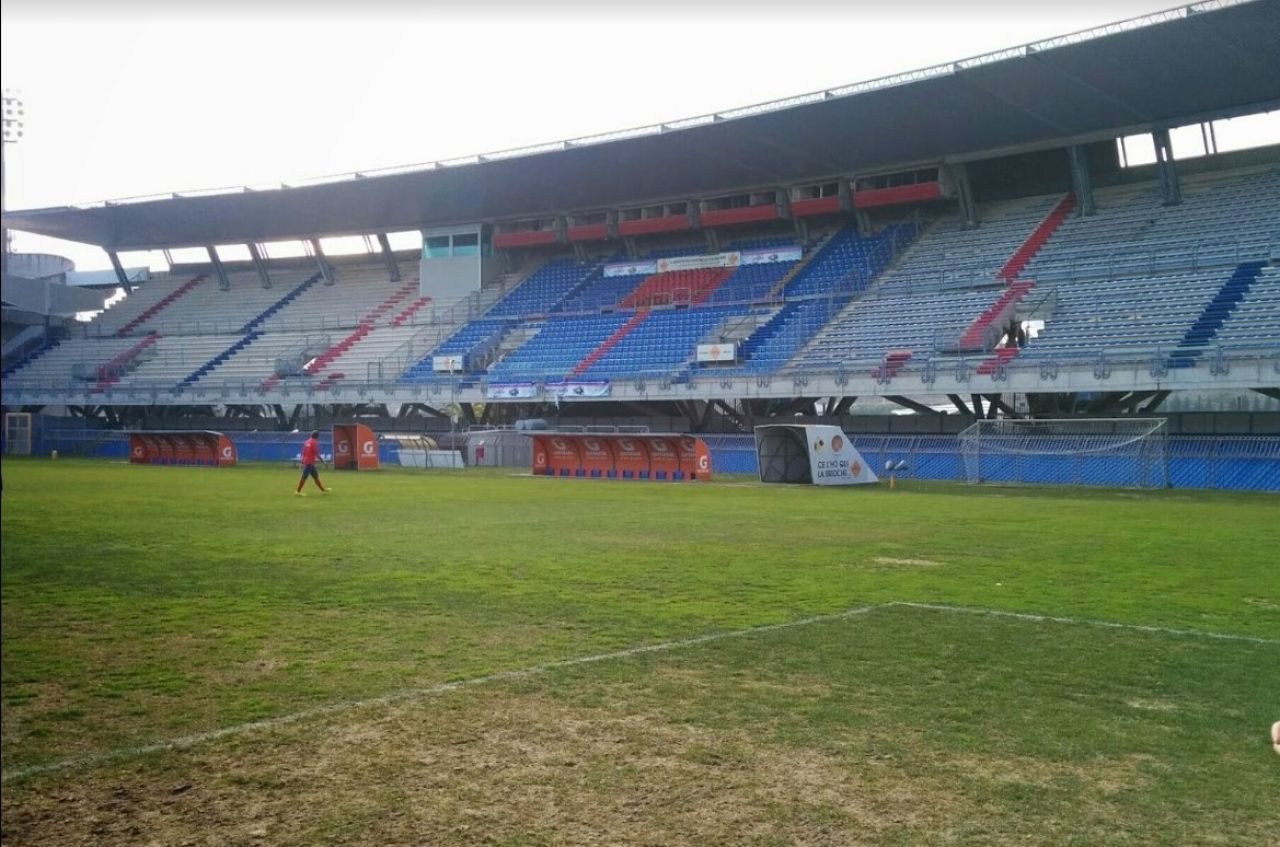
Planning for the construction of a sports field

In the recent procurement code, the principle of result has been incorporated. This is in fact based on the relationship between costs and benefits and considers economic, social and environmental sustainability in all phases of the life cycle of a public work.
During the programming phase, it is essential to conduct an in-depth study to identify the optimal solutions, encouraging discussion between experts and interested parties.
First of all, it is necessary to draw up the needs framework which takes into account what is foreseen in the three-year planning tools. In relation to the type of intervention itself, it reports:
a) the general objectives to be pursued through the implementation of the intervention, with the associated key performance indicators;
b) the requirements, qualitative and quantitative needs of the client, the community or the specific user for whom the intervention is intended, which must be satisfied through the implementation of the intervention itself.
Secondly, the feasibility document of project alternatives (DOCFAP) must be drawn up. It is drawn up in compliance with the contents of the requirements framework, identifies and analyzes the possible design solutions which may concern:
- the hypothesis of non-implementation of the intervention;
- the alternative between the construction of a new construction or the recovery of the existing field, or the reuse of abandoned or urbanized or degraded areas, limiting further land consumption and in the case of new construction, identifies the location of the intervention;
The DOCFAP can also analyze the technical, economic and financial solutions, also in relation to the maintenance aspects of the work to be carried out. The DOCFAP can take into consideration and analyzes all possible options, including, where applicable, the hypothesis of non-implementation of the intervention, in order to allow an effective comparative comparison between the different alternatives.
The DOCFAP also highlights the main impacts of the alternatives analyzed on the territorial, environmental, landscape, cultural and archaeological context, as well as, for interventions on existing works, on the historical, architectural and technical characteristics. To this end, the possibility of carrying out preliminary investigations is envisaged.
Thirdly, it is necessary to draw up the design guidance document, hereinafter "DIP", to be drawn up in coherence with the requirements framework and with the solution identified in the DOCFAP. The DIP indicates the characteristics, requirements and design documents necessary for the definition of each level of the design.
If you have chosen a natural hybrid grass playing field, it is essential to involve a designer expert in Landscape, Environment and Naturalization, so that the project is developed in accordance with the new procurement code and respects environmental requirements. Depending on the predominance of the value of the works, the structural works of a sports center such as changing rooms, stands, internal paths, fencing, lighting, etc. they fall into the building category E.11 "Culture, Social Life, Sports, Worship" which includes "Areas and equipment for outdoor sports, sports fields and simple related services". On the contrary, the works relating to a natural hybrid grass sports field, including drainage systems and irrigation systems serving the green area, are classified in category P.02 "Green interventions and works for recreational or sporting activities", which includes "Green works, both on a small and large scale, where the relevance of the work is predominant compared to those of a construction type."
The needs that become needs in modern society

The creation of an amateur sports center does not focus exclusively on the objective of advancement in the field of competitive sport, but rather highlights the need to create a meeting place for socialization through sporting activity. The main objective is to provide an educational model that complements school education, allowing individuals to learn from coaches how to properly prepare for a match, respect opponents and work as a team. These principles are fundamental for building a fair and non-violent society, in which differences can be resolved through sporting competition.
By participating in sporting events with different communities, children understand that diversity is not a reason for exclusion, but rather a possibility to understand cultural differences and how to broaden their knowledge. Team sports, although they involve a large number of athletes, teach how important leadership and teamwork are for collective success.
Football is widely popular due to its simplicity, but there are many other sports that can be played on a grass field that require different skills, for example rugby, American football, lacrosse, etc. Some of these sports, such as rugby and "flag" or "tag" football, do not involve physical contact, making them ideal for people of different abilities and genders. This makes them particularly suitable for school activities. It is worth remembering that in the United States, for example, every educational institution plays football, and in the United Kingdom, rugby.
These sports require large playing spaces, thus underlining the need for multifunctional sports facilities that guarantee safety and accessibility, to meet the needs of a large number of citizens. It is common for local authorities to offer grants for new sports center projects or the redevelopment of existing ones, but it is important to ask the following question.
Natural grass or synthetic grass?

Natural grass is preferred by many professional players for its better grip, softness and effectiveness in preventing sprains, injuries and back pain. However, its maintenance can be demanding and expensive especially in areas with rapid climate changes. Some maintenance practices may involve the use of chemicals that are harmful to the environment and health and, in extreme cases, require the repair or replacement of the lawn, further contributing to a negative environmental impact.
Today, to reduce maintenance costs and respond to a demand for greater use, many operators opt for the installation of artificial pitches. However, it is known that playing on artificial grass has some differences compared to playing on natural grass: the bounce and control of the ball change and the player's grip on the surface, especially when it is wet, decreases, making the game less safe and spectacular. Finally, the heat from the artificial pitch can be annoying for both players and spectators.
Maintenance of artificial pitches is often poor and difficult to monitor, due to their ever-green appearance; in fact, their duration can often be exceeded, putting players at risk. Over time, the fibers lose resilience and lie down on the surface and players may complain of back pain if the pitch becomes hard, joint sprains and muscle strains due to the reduced grip of the artificial pitch. Further problems can arise when temperatures rise, causing skin abrasions from falls and premature fatigue caused by heat radiated from the court surface.

"It's obvious that you play better on the artificial pitch than on the natural one with holes, but if we could play on a resistant natural pitch for matches and training, without holes and with low maintenance, we would have achieved the desired goal."
Dr. Niko Sarris
Hybrid systems aim to combine benefits and reduce negative effects
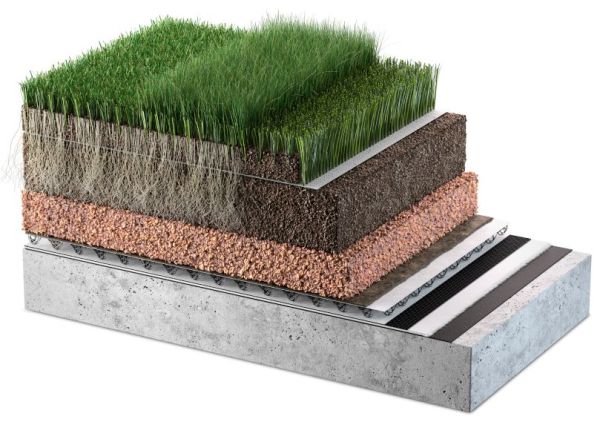
Integrating synthetic turf into natural grass has been a goal pursued by the industry for the past 30 years, but it has not always been successful. All hybrid grass systems should meet the expectations of greater resistance and durability which makes the work of maintenance technicians more complex and it must not be forgotten that the presence of the synthetic turf sometimes limits the possibility of mechanical interventions and often makes the surface too solid both for the game and for the root development of the natural grass.
Today there are synthetic carpets with an open support which allows the roots to penetrate and anchor themselves, thus obtaining greater resistance to tearing. The synthetic fibers that protrude onto the surface above the infill protect the plants from intensive use, forming a durable playing surface in which natural grass prevails, also known as "reinforced natural grass", "hybrid grass" or "mixed grass".
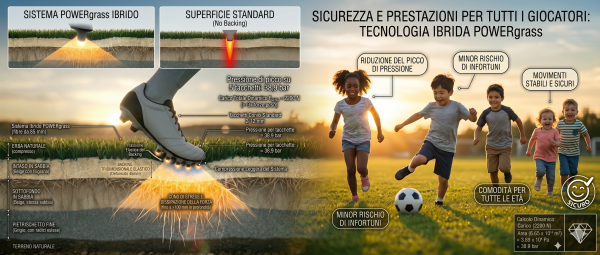
In hybrid fields the game takes place on natural grass and the presence of synthetic grass is almost imperceptible because in fact it is less than 5%, therefore, they are equivalent to natural grass fields from every point of view. Shoe studs interact with natural grass but do not raise the turf on hybrid fields. The game is played with greater safety and damage to the natural grass is limited, in particular reducing post-match restoration operations. When the natural grass suffers damage, the synthetic fibers guarantee continuity of play until regrowth, making the groundsman's work quick and easy.
Hybrid grass systems are appreciated by professional players because they make the playing surface more stable by anchoring the grass to the synthetic support, which would otherwise give way during play and form potentially dangerous holes. The player feels more confident and gives the best of himself, allowing spectacular plays.
The POWERgrass hybrid turf system solves the problem!
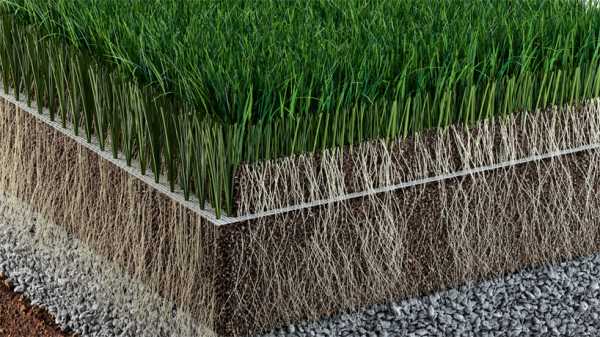
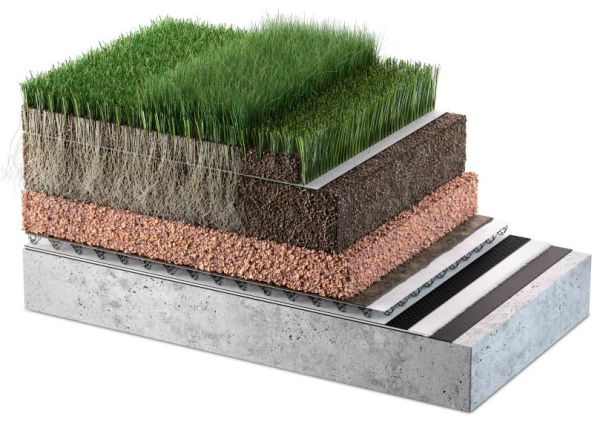
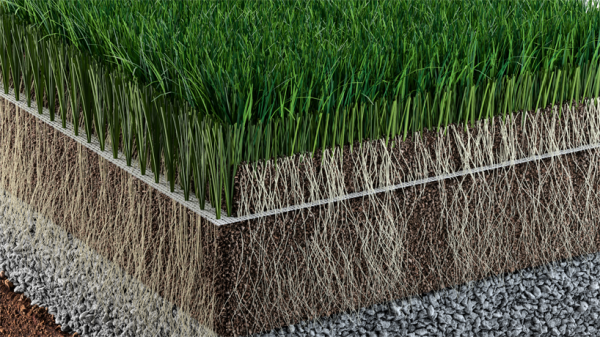
The POWERgrass hybrid system was developed holistically. The synthetic support has numerous three-dimensional holes arranged uniformly which limit the migration of sand, thus preventing the holes from clogging and hardening the system. The synthetic support is soft but resistant to tearing and deep aeration and maintains its characteristics over time. The roots of natural grass grow deep from the first day of growth and, once they pass through the support, are protected from abiotic and biotic stresses.
The synthetic fibers are strong, resistant and thermally bonded to the three-dimensional support to allow correct installation and facilitate maintenance, so that they remain upright to truly protect the crowns of plants on the surface. Once the system is installed, the synthetic fibers protrude approximately 20-25 mm into the surface before sowing.
ZOEsand is a soil improver for sports use resulting from an in-depth study to improve the physical and chemical properties of sand. It is made up of three essential components: one elastic, one organic and one mineral to be mixed with USGA type sand. ZOEsand makes the growing medium softer, more fertile and more resistant to soil compaction.
The POWERgrass hybrid turf system is the combination of a synthetic grass surface made with an ad hoc backing, a sand-based substrate amended with elastic, organic and mineral elements such as ZOEsand and the natural grass inseminated in the synthetic turf. The system is installed on site by expert personnel and maintenance is developed by the working group according to the POWERgrass experience following the principles of regenerative agriculture to also obtain a positive environmental impact.
The final result of a successful installation is a sports surface with greater traction, stability and softness, highly draining to play safely even in the rain, even without natural grass and, above all, without dangerous holes.
The natural grass with its roots anchors itself in the holes of the support and at the same time aggregates the sand to the synthetic grass. The system is therefore functional and appropriate in areas at risk of flooding, it takes into account the need for high permeability but reduces the risk of dispersing waste or polluting substances into the aquifers.
The life of the system is indefinable, without an expiration date, if it is maintained regularly thanks to the self-repairing capabilities of natural grass. In the context of managing a sports center between 10 and 20 years, it is the best choice because it reduces management costs and allows the field to be returned to a better state.
Attachments

Insights
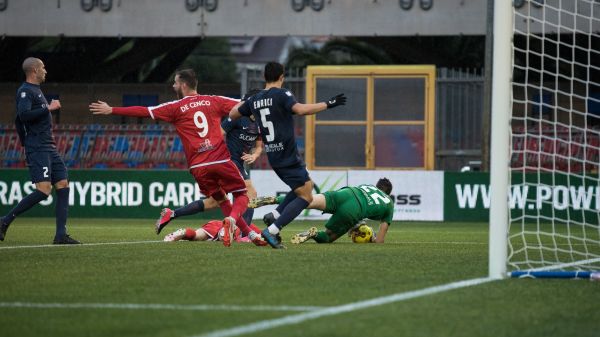
The perfect FIFA 2026 pitch
In search of excellence in the perfect field, POWERgrass could not be missing! And now with the first results they confirm...
Show moreThe perfect FIFA 2026 pitch
Sport and Suburbs 2026
It is aimed at municipalities with over 5000 inhabitants, also in associated form, with a focus on the recovery of...
Show more