
Foliar fertilization, design and application
Without a doubt it is the best way to start the teachings of regenerative agriculture because it is possible to quickly re-establish nutritional balance and enhance the photosynthesis process before the situation worsens.
Without plants the soil would be decaying rock.

It is often said that good soil is needed for plants to grow well. This statement is correct but incomplete because in reality it is the plants that generate the soil by promoting the numerous biological processes that take place within it. Only plants in excellent health can improve the properties of the soil by sending part of the sugars they produce through photosynthesis to nourish the microorganisms, through root exudants.
In regenerative agriculture the most stimulating part is to understand what is the point of maximum yield with the minimum distribution of product, letting nature take its path.
Foliar applications are the key to quickly achieve this result. They can accelerate the recovery process of plants after biotic or abiotic stress and there are further benefits because they improve plant resistance, production and quality in a very rapid and minimally invasive time.
An agronomist expert in nutrition said: "you need to apply the fertilizer in a way that the roots can avoid it." His statement means that since most granular fertilizers are salts and we know that all salts are devastating to biological activity, it is good to make sure that the plants can be fed without damaging the biology of the soil. In short, he has demolished all the teachings of the synthetic fertilizer industry but we know he is right.
Many use foliar applications to correct a nutritional deficiency of microelements or for a fungicidal curative treatment. However, you need to think of foliar applications as the main nutritional system of the regenerative agriculture method and not as a spot treatment to solve a specific problem. The most important aspect concerns how to design foliar applications correctly because the results can change significantly. Attention must be paid to the mixing sequence of the products in the barrel, the quality of the water and other aspects.
Definition - What does Brix mean?
Brix is a unit of measurement for evaluating dissolved solids in fruit and vegetable juices. These solids include amino acids, proteins, minerals, vitamins, and the sugars fructose and sucrose.
It is important to know the brix level (°Bx) of fruits and vegetables to determine and plan soil management practices. It also helps gardeners improve soil by determining whether they need to increase organic matter and nutrient ratios in the soil.
Brix may also be known as plant sap analysis.
The higher the brix level in fruits and vegetables, the healthier the plant. Plants with a high brix level tend to taste better and can be stored for longer periods of time. In fact, high brix fruits and vegetables don't rot as easily. Plants high in brix are known to produce seeds that germinate faster, resisting both frost and heat damage.
To measure brix, gardeners often use a device known as a refractometer. This device is very often used in viticulture to monitor the ripening process of grapes. To use the refractometer, winemakers roll a leaf sample into a ball and squeeze a few drops into the device. The brix level will appear on a graduated scale.
The starting point for creating a healthy crop and healthy soil
Foliar applications are the best method at the beginning of a crop to progressively increase brix in the plant until the symbiotic processes of regenerative agriculture are activated. As the system becomes healthier the greater the effect of the foliar application will be and the longer it will last over time. For example, a foliar application starting from a plant at a 4 brix level can quickly reach 12 brix within 30 minutes or a maximum of 3 hours. If after 24 hours there is no noticeable change on the leaf, the application has had no effect and we need to understand the reason. Obviously a single application at the beginning cannot last long and the brix level can drop to 4.5 brix within 3 days so a second application is necessary but the point is that the second application will have a better effect and will last longer than the first and the minimum brix level will be slightly higher for example 5. Progressively the third, fourth and all subsequent foliar applications will contribute to raising the minimum brix threshold, ensuring that the effect is always better and the duration is longer until six weeks.
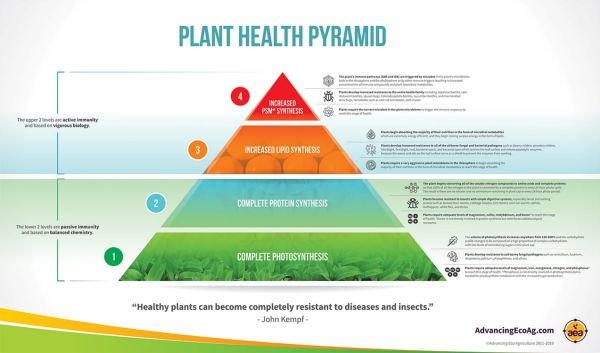
It is known that when the minimum brix threshold is kept above the value 16, plants are largely resistant to diseases and insects.
When the minimum brix threshold is high enough we no longer need to make other foliar applications to maintain their health because we have in fact created the regenerative agriculture system.
Once a foliar application has been designed, it is always a good idea to analyse the plant's sap before and after the application. The analysis of the plant's sap will almost always tell us which elements are necessary to integrate but an important aspect that we can note is the fact that often, in addition to the elements applied, the plant also tends to absorb other elements that were not present in the barrel. For example, a foliar application that contains iron and manganese can have a positive effect not only by increasing the elements applied but also by increasing zinc, copper and boron. This is due to the optimization of photosynthesis in the leaves which produces sugars to be sent through the roots to the microorganisms in the soil and consequently stimulate them to mineralize other elements from the soil and then transfer them to the plant in a more noble form.
Another way to verify the effect of the foliar application is to create the intended mix and then test it in a small area, measuring the brix measurement before and after the treatment 2-4 hours apart. This way you can test multiple mixes before even performing the application. For example, if from the first measurement we have 3 brix and after three hours we measure a peak of 6 brix or 8 brix there will certainly be an increase in the peak up to 24 or 48 hours.
In summary, it is possible to measure the efficiency of the foliar application within a short time even before applying the product. In fact, it is possible to observe different results between one mixture and another than expected.
Design foliar application
In general in the barrel you need to add:
- Clean water
- Dispersants/Adhesives/Surfactants
- Mineral nutrients for plants
- Biostimulants for plants (algae extracts)
- Biostimulants for microorganisms (fulvic acids)
- Microorganism inoculants (Mirco 5000)
Nutrients are the minerals (N, P, K, Mg, Ca, S, Fe, Zn, Mn, Cu, B, Mo) that we believe are necessary at a certain point in cultivation or those that are found to be lacking after an analysis of the leaf sap.
Biostimulants for plants are growth hormones such as auxins, cytokinins, gibberellins and abscisic acid, or natural extracts from marine algae or enzymes.
Biostimulants for microorganisms are fulvic acids, humic substances and also natural extracts of marine algae and some enzymes that stimulate existing biological activity.
Microorganism inoculants are intended as cultures of additional microorganisms to be integrated into the barrel.
Dispersants/Adhesives/Surfactants are very useful for increasing adhesion to the leaf surface.
Integrate in the following sequence:
- Clean water
- Pesticides
- Mineral nutrients for plants
- Biostimulants for plants
- Biostimulants for microorganisms
- Microorganism inoculants
- Dispersants/Adhesives/Surfactants
After selecting and testing the clean water (see below), you must fill the barrel up to 80-90%, especially when a pesticide is to be applied so that it is diluted as much as possible before applying a biostimulant or inoculant. Otherwise, if a biostimulant, an inoculant and the pesticide are applied first, there is a risk of damaging the populations from the concentration of the pesticide when it falls into the barrel even if it is diluted within a few seconds.
Dispersants/Adhesives/Surfactants should be added last because they can interact differently when added in a very concentrated form.
What is clean water for a foliar application
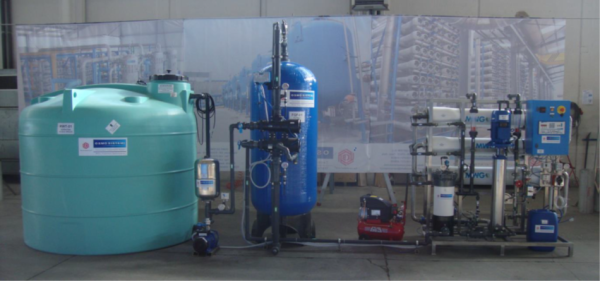
Clean water must contain less than 70 ppm (5 grains) of total hardness. What makes water hard is calcium, magnesium, bicarbonates and carbonates. The most recurring problem occurs with calcium bicarbonates. Bicarbonates and carbonates are the primary concern because they are anions that bind with whatever you add to the barrel. Water with total hardness above 150 ppm (10 grains) can reduce the performance of the applied product by up to 70%. This applies to every product added to the barrel.
Water quality is the major limiting factor for almost all foliar applications. Use rainwater, reverse osmosis filtered water, or clean, laboratory-tested water to ensure quality.
Clean water with reverse osmosis requires an investment of 4-5 thousand euros but can reduce the application dosage by 30-50%. The same also applies to herbicides, insecticides and fungicides. There are some who, after filtering the water with reverse osmosis and structuring it, have managed to reduce the dosage by up to 70%.
Note: avoid softened water because sodium and chlorine are present, filtered water because bicarbonates and carbonari are not removed, pond or stream water unless it is tested and is clean because often if it filters through the rocks it can take on bicarbonates and carbonates, water of the aqueductbecause chlorine is present or acidified water because the acidifiers on a water with 500 ppm of total hardness can have an action of lowering the pH for example from 7.4 to 5.5 but neutralizes only 30-40% of the bicarbonates and carbonates in the water; after 24 hours the pH rises again because the remaining bicarbonates and carbonates are fixed with the acids and reduce the acidifying action and can be calculated mathematically.
Product synergies
The applications of synergistic products have a greater effect on the plant if applied with this priority:
- Nutrient minerals for plants
- Biostimulants for plants (algae extracts) à
- Biostimulants for microorganisms (fulvic acids) à
- Fungal inoculants à
- Bacterial inoculants.
Biostimulants work much better if plants have the right amount of the mineral nutrients they need. If, for example, we have to make a foliar application and we have a lack of magnesium and manganese in the plant and we want to apply seaweed, the effect of the seaweed will be much better if the plant receives an adequate quantity of magnesium and manganese. As the health of the plant improves, the use of biostimulants is less necessary because the plant alone is able to synthesize its hormones, enzymes, etc.
The characteristics of the foliar solution
- Check the pH for best results of the formulated solution. The optimal one is between 5.2 and 6.4. The products usually have an acidifying action to bring the pH of the solution into this range without the use of further acidifiers.
- Check the Electrical Conductivity if foliar applications are carried out every 10-14 days the EC must be less than 3800 ppm. Otherwise we have too high the EC on the leaves. However, if foliar applications are carried out every 30-40 days this is not a concern.
- Deliquescence point: is the point of humidity in the atmosphere at which a drop on the surface of the leaf dries out or remains liquid. The solutions must contain small quantities of materials with a high deliquescence point such as marine algae, magnesium chloride, potassium nitrate, or calcium nitrate so that the drop we sprayed on the leaves remains liquid for longer even in dry conditions. We have to think differently to get nutrients absorbed by the leaf surface because we know that there is absorption by the stomata, diffusion through the membranes but perhaps we underestimate the impact of microorganisms on the leaves which can metabolise the nutrients present in the drop of water and make them absorbed more quickly by the plants.
When to apply foliar treatments
The right time is in the evening or early in the morning. Morning is the absolute best time but can also be more difficult to do.
You should avoid applying:
- During the rain
- When there is heavy dew because the drops can fall together with the dew, carrying the product away; it obviously depends on the quantity of water necessary for the foliar application but above 140 l/ha the drops will fall to the ground.
- When the temperature on the surface of the leaves exceeds 25.5°C.
The efficiency of foliar application on healthy systems compared to unhealthy ones
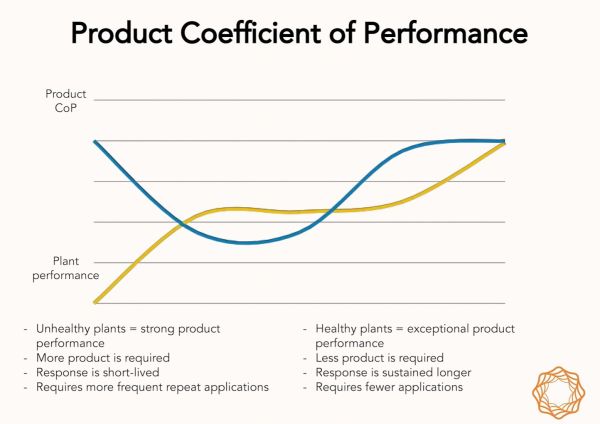
The yellow line represents the photosynthesis potential of the plant compared to its health state from left to right. On the left, plants have abiotic stress (drought) or nutrient deficiency so the potential for photosynthesis is between 5-10%. At the point of the first crossing of the yellow line with the blue one we have the healthiest plants that exploit the potential of photosynthesis to a greater extent by 15-20%. By improving the health of the plant it begins to exploit 40% of the photosynthesis potential.
The blue line instead represents the effect of the foliar application. When the plant is under stress we have an explosion of the result of the foliar application but as mentioned after the effect does not last long. In the intermediate health range for a period the foliar application does not seem to have a great effect but from a certain point onwards when the state of health improves the effect of the foliar application increases drastically again with lower dosages at longer intervals.
|
Plants with precarious health |
Plants in excellent health |
|
|

Related topics

Environmental benefits
6 points of merit on our fields

Heat islands
Mitigation and green contribution

Foliar fertilization
What it is, design and application
Write to Us
For any kind of request write to us.