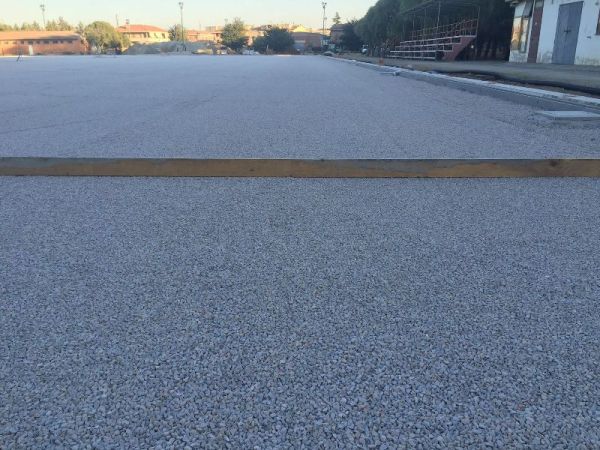
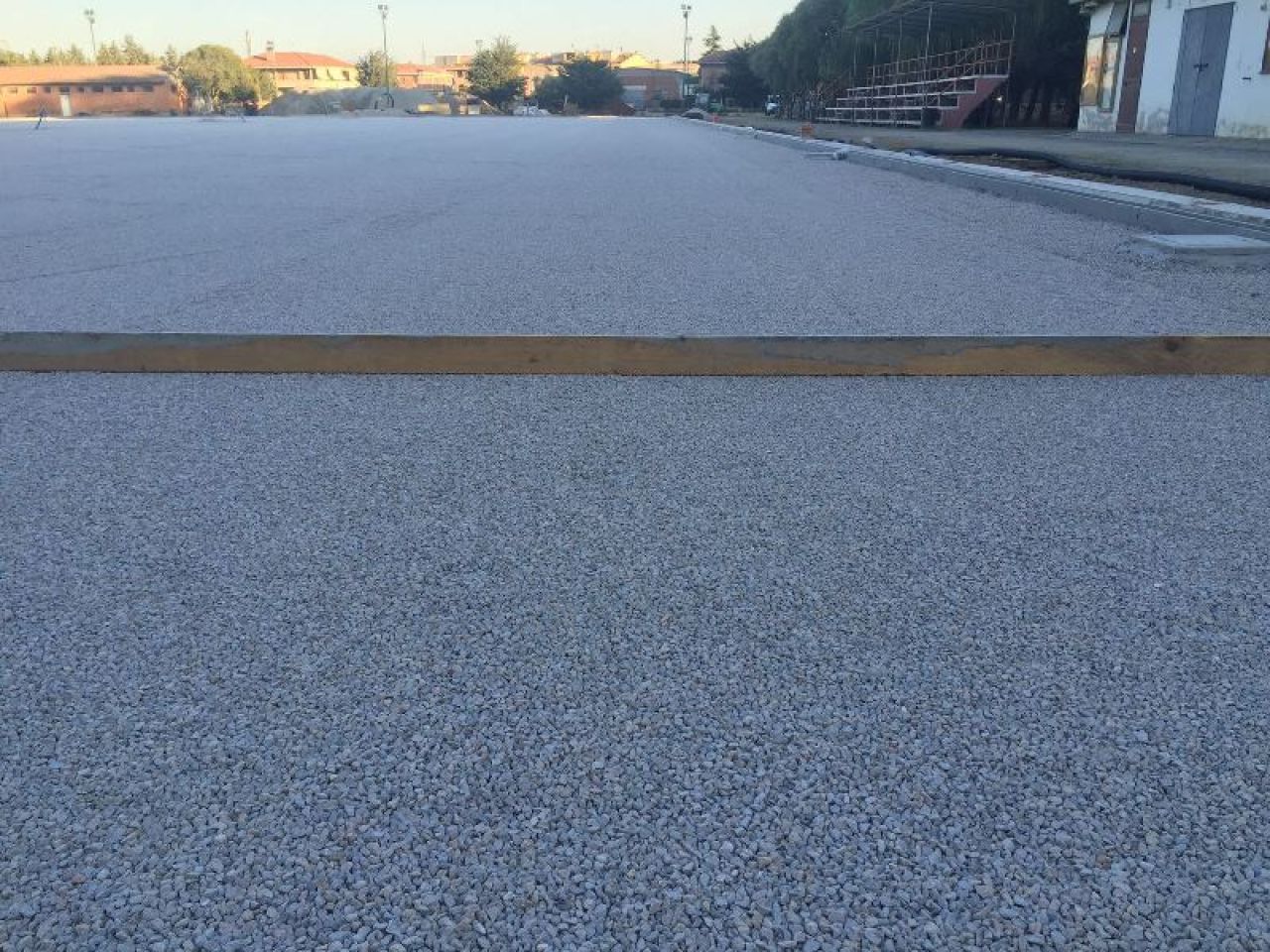
The layer of crushed stone is placed uniformly between the drainage network with the pipes arranged in trenches and the sandy growth layer, in compliance with USGA standards to create the "suspended water table" subgrade system. In this type of subgrade, the water remains suspended in the sandy growth substrate, thanks to the capillary forces between the grains of sand until complete saturation. However, in the case of heavy rainfall, the excess water filters into the layer of gravel by gravity and quickly moves away through the continuous flow into the underlying drainage pipes. A few hours after the end of the rain, the water necessary for the growth of the grass remains in the plant substrate and the so-called "field capacity" of the substrate is reached which keeps the water ÷ air ratio in the rhizosphere in balance.
The USGA method is still the best method known for creating golf greens and prestigious sports fields that are resistant to trampling and highly draining. The system manages to maintain the water ÷ air ratio in the growth substrate more uniformly over the entire surface than any other system.
The choice of crushed stone seems trivial but it also depends on the characteristics of the sand. The selected crushed stone can be placed in contact with the upper layer of sand as long as the conditions shown in the following table exist.
Performance factors
Recommendations
Splicing Factor
D15 (gravel) ≤ 8xD85 (top soil)
Permeability Factor
D15 (gravel) ≥ 5xD15 (top soil)
Uniformity Factors
D90 (ballast) / D15 (ballast) ≤ 3
No particles larger than 12 mm
No more than 10% less than 2 mm
No more than 5% less than 1 mm
The table is based on engineering principles according to the criterion that relates the largest 85% of top soil particles to the smallest 15% of crushed stone particles. In practice, a sort of "connection or junction bridge" is highlighted between the larger component of the upper layer (which has an overall fine grain size) with the smaller component of the lower layer (which has an overall coarser grain size). This prevents the migration of finer particles into the coarser lower layer and at the same time ensures good permeability.
D85 (top soil) can be defined as the particle diameter below which 85% of the particles (by weight) are smaller.
D15 (crushed stone) can be defined as the particle diameter below which 15% of the particles (by weight) are smaller.
For the "junction" to occur, D15 (gravel) must be less than or equal to 5 times D85 (top soil).
To maintain adequate permeability through the layers (from the top soil to the underlying gravel) D15 (gravel) must be greater than or equal to 5 times D15 (top soil).
Finally, to ensure good uniformity of the layers, the crushed stone must have a uniformity coefficient (D90 crushed stone / D15 crushed stone) less than or equal to 2.5.
Note: if it is not possible to respect all the parameters in the table, it is necessary to place an intermediate layer between the layer of crushed stone and the sandy top-soil.
The layer of crushed stone is placed uniformly between the drainage network with the pipes arranged in trenches and the sandy growth layer, in compliance with USGA standards to create the "suspended water table" subgrade system. In this type of subgrade, the water remains suspended in the sandy growth substrate, thanks to the capillary forces between the grains of sand until complete saturation. However, in the case of heavy rainfall, the excess water filters into the layer of gravel by gravity and quickly moves away through the continuous flow into the underlying drainage pipes. A few hours after the end of the rain, the water necessary for the growth of the grass remains in the plant substrate and the so-called "field capacity" of the substrate is reached which keeps the water ÷ air ratio in the rhizosphere in balance.
The USGA method is still the best method known for creating golf greens and prestigious sports fields that are resistant to trampling and highly draining. The system manages to maintain the water ÷ air ratio in the growth substrate more uniformly over the entire surface than any other system.
The choice of crushed stone seems trivial but it also depends on the characteristics of the sand. The selected crushed stone can be placed in contact with the upper layer of sand as long as the conditions shown in the following table exist.
Performance factors
Recommendations
Splicing Factor
D15 (gravel) ≤ 8xD85 (top soil)
Permeability Factor
D15 (gravel) ≥ 5xD15 (top soil)
Uniformity Factors
D90 (ballast) / D15 (ballast) ≤ 3
No particles larger than 12 mm
No more than 10% less than 2 mm
No more than 5% less than 1 mm
The table is based on engineering principles according to the criterion that relates the largest 85% of top soil particles to the smallest 15% of crushed stone particles. In practice, a sort of "connection or junction bridge" is highlighted between the larger component of the upper layer (which has an overall fine grain size) with the smaller component of the lower layer (which has an overall coarser grain size). This prevents the migration of finer particles into the coarser lower layer and at the same time ensures good permeability.
D85 (top soil) can be defined as the particle diameter below which 85% of the particles (by weight) are smaller.
D15 (crushed stone) can be defined as the particle diameter below which 15% of the particles (by weight) are smaller.
For the "junction" to occur, D15 (gravel) must be less than or equal to 5 times D85 (top soil).
To maintain adequate permeability through the layers (from the top soil to the underlying gravel) D15 (gravel) must be greater than or equal to 5 times D15 (top soil).
Finally, to ensure good uniformity of the layers, the crushed stone must have a uniformity coefficient (D90 crushed stone / D15 crushed stone) less than or equal to 2.5.
Note: if it is not possible to respect all the parameters in the table, it is necessary to place an intermediate layer between the layer of crushed stone and the sandy top-soil.
The layer of crushed stone is placed uniformly between the drainage network with the pipes arranged in trenches and the sandy growth layer, in compliance with USGA standards to create the "suspended water table" subgrade system. In this type of subgrade, the water remains suspended in the sandy growth substrate, thanks to the capillary forces between the grains of sand until complete saturation. However, in the case of heavy rainfall, the excess water filters into the layer of gravel by gravity and quickly moves away through the continuous flow into the underlying drainage pipes. A few hours after the end of the rain, the water necessary for the growth of the grass remains in the plant substrate and the so-called "field capacity" of the substrate is reached which keeps the water ÷ air ratio in the rhizosphere in balance.
The USGA method is still the best method known for creating golf greens and prestigious sports fields that are resistant to trampling and highly draining. The system manages to maintain the water ÷ air ratio in the growth substrate more uniformly over the entire surface than any other system.
The choice of crushed stone seems trivial but it also depends on the characteristics of the sand. The selected crushed stone can be placed in contact with the upper layer of sand as long as the conditions shown in the following table exist.
Performance factors
Recommendations
Splicing Factor
D15 (gravel) ≤ 8xD85 (top soil)
Permeability Factor
D15 (gravel) ≥ 5xD15 (top soil)
Uniformity Factors
D90 (ballast) / D15 (ballast) ≤ 3
No particles larger than 12 mm
No more than 10% less than 2 mm
No more than 5% less than 1 mm
The table is based on engineering principles according to the criterion that relates the largest 85% of top soil particles to the smallest 15% of crushed stone particles. In practice, a sort of "connection or junction bridge" is highlighted between the larger component of the upper layer (which has an overall fine grain size) with the smaller component of the lower layer (which has an overall coarser grain size). This prevents the migration of finer particles into the coarser lower layer and at the same time ensures good permeability.
D85 (top soil) can be defined as the particle diameter below which 85% of the particles (by weight) are smaller.
D15 (crushed stone) can be defined as the particle diameter below which 15% of the particles (by weight) are smaller.
For the "junction" to occur, D15 (gravel) must be less than or equal to 5 times D85 (top soil).
To maintain adequate permeability through the layers (from the top soil to the underlying gravel) D15 (gravel) must be greater than or equal to 5 times D15 (top soil).
Finally, to ensure good uniformity of the layers, the crushed stone must have a uniformity coefficient (D90 crushed stone / D15 crushed stone) less than or equal to 2.5.
Note: if it is not possible to respect all the parameters in the table, it is necessary to place an intermediate layer between the layer of crushed stone and the sandy top-soil.