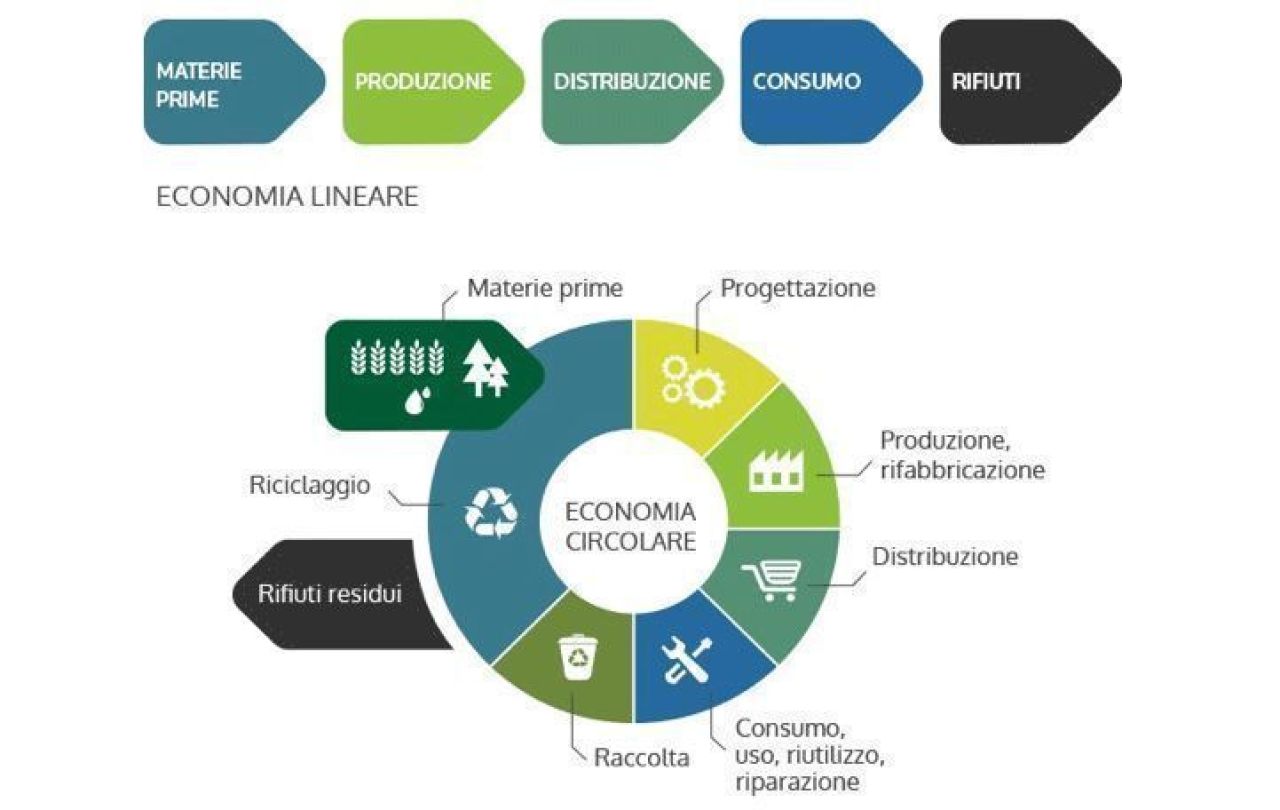
We have been hearing about the circular economy for many years without understanding what it means or rather how to apply it. Ordinary people think that it is simply about designing products to be recycled at the end of their life, but it is much more. We must be aware of the need to reduce the production of waste and the use of polluting substances, limit the consumption of materials and natural resources, maintain the existing environment in a sustainable way, compensate for greenhouse gas emissions and, finally, measure the effectiveness of our actions. In short, we need to reschedule and monitor our every activity.
From the website of the European Commission we learn that no less than 1,000,000,000.00 (one trillion) euros will be invested for the new development strategy in the countries of the European Union.
Climate change and environmental degradation are a huge threat to Europe and the world. To overcome these challenges, Europe needs a new growth strategy that transforms the Union into a modern, resource-efficient and competitive economy in which:
The European Green Deal is our roadmap to making the EU economy sustainable. We will achieve this goal by transforming climate issues and environmental challenges into opportunities across all policy sectors and making the transition fair and inclusive for all.
The European Green Deal includes an action plan aimed at:
The plan illustrates the necessary investments and available financing tools and explains how to ensure a fair and inclusive transition.
The EU intends to achieve climate neutrality in 2050. We have proposed a European Climate Law to turn this political commitment into a legal obligation.
Achieving this goal will require action from all sectors of our economy, including:
2020 has thrown the world into chaos that was long predicted, but hardly prepared for. Covid-19 has held a magnifying glass on the flaws of the global economy – flaws that have long been clear, but which society has continued to press the “silence” button.
For the first time ever, the amount of material consumed by our global economy also exceeded 100 billion tons, of which only 8.6% was recycled in the economy - a sober indicator of the progress we still have to make.
But if we've learned anything from 2020 so far, it's to "never let a crisis go to waste." The pandemic has created space on the global stage for the concept of “building back better.” This is an opportunity we must not miss.
We must therefore act with determination to accelerate the transition towards a circular economy and to guarantee a socially just and ecologically safe space for all. Below are some reflections on how circularity and resilience have become intimately linked to our activities and the broader ecosystem of actors we work with. We also look at the road ahead and what a system fit for an inclusive and resilient 21st century world might look like.
Rarely have the flaws of our global economy come together so prominently as under our collective experience of covid-19. Interdependent global supply chains, material extraction that occurs at a faster pace than remanufacturing, and an economic model focused on profit-making and endless growth at the expense of stability and resilience have been the hallmark of the "waste-taking" tradition. The pandemic has only served to draw the curtain on these defects.
Covid-19 has also had a disproportionate impact on low- and middle-income countries and minority groups within higher-income countries. These impacts have included increased rates of infection, deaths and job losses, highlighting entrenched inequalities in access to basic services such as clean water, healthcare, safe working conditions and social safety nets. The alarm has been raised once again to address systemic inequalities and it seems the world is finally listening that there is no environmental justice without social justice.
Now, the scale of the response must match that of the emergency. By engineering out waste and pollution, keeping products and materials in use, and regenerating natural systems, a circular economy allows us to collectively reimagine and redesign our systems to ensure an ecologically safe and socially just space for us all. A world where functioning social systems fall within healthy planetary boundaries. The circular economy now also has the opportunity and duty to further incorporate equality and resilience into this model.
Even before the pandemic, city officials and urban change makers have long been early adopters of the circular economy. It offers direction in reimagining cities that are resilient to future shocks and that strive for equality and access across the board. Now, mayors and leaders of the world's largest cities warn that there may be no return to business as usual as economies begin to rebuild.
But to translate the promise of the circular economy into practical, scalable action, they need guidance. Which strategies should be implemented and encouraged, in which sectors, together with which departments and why?
The city of Amsterdam has once again proven itself to be a cutting-edge circular city. Amsterdam's Circular Strategy 2020-2025 reinforces the city's plan to become fully circular by 2050. Integral to the plan is Doughnut Economics, a model developed by Oxford economist Kate Raworth, and scaled to meet the city's needs by different organisations. In this model it is clear that the circular economy is based on a healthy dynamic between social and ecological issues.
The pandemic has exposed the fragility inherent in many businesses and forced many to prioritize managing the immediate consequences of covid-19. But we've also seen a renewed focus on the importance of mitigating risk and building resilience across businesses of all sizes.
A circular business model is an integral part of adapting business to be fit for purpose in the 21st century. It is necessary to stimulate and support companies in building their capacity to embrace the changes necessary to move from a linear to a circular economic model.
There cannot be a global and circular transition without the commitment of countries: they have the mandate to develop national and international legislation and to create an environment conducive to the transition. As leading investors in infrastructure, government buildings and assets, their procurement strategy can also enable large-scale circularity. Now, the circular economy is increasingly at the forefront of sustainability strategies for countries around the world.
The Netherlands has embarked on a linear path in key sectors such as construction and agriculture, for example, and that a transformation is needed if the country is to reach the ambitious target of 100% circularity by 2050.
The pandemic has revealed the fragility and vulnerability of the current labor market, which revolves around maximizing efficiency and minimizing financial costs. It also highlighted key questions about how we value, think about and value work today, including the roles we consider vital to society.
The Circular Jobs Initiative (CJI) was launched in March this year by the Circle Economy to ensure the creation of a circular jobs market that allows both workers and the planet to thrive.
Because the circular economy relies on processes that require more labor than in the linear economy - where resources are often wasted or incinerated rather than repaired and reused - the transition is expected to be labor-intensive at first. This is an opportunity to promote decent and equal work and create new and more diverse skill sets and job roles.
HOW TO DO IT?
Times of global crises can bring about change. Before the pandemic hit, we were already at a social and economic crossroads. Calls for systemic transformation, away from the dominant capitalist and linear systems, were growing. The transition towards a circular system suitable for the world of the 21st century is therefore necessary, where production cannot continue to be the dominant principle of our relationship with the world.
Importantly, we are now armed with the knowledge that the economy can be held together comprehensively and simultaneously. This means it can change, specifically:
We must redefine prosperity: Growth for the sake of growth is not sustainable, nor does it take into account the well-being of human beings. A socially just space should aim to actively address society's endemic discrimination and racism that limits equality between groups. Ultimately, dominant social, economic and political power structures facilitate processes that benefit neither people nor the planet. A circular economy can aim to facilitate a system that does not perpetuate these same mistakes.
We must reintegrate with nature and the commons: Human beings have long found ways to arrange and manipulate nature. But every time we talk about the circular economy, we essentially invoke the emulation of nature. In the natural world, waste does not exist. Our industrial systems can mirror ecosystems, an increasingly important concept as raw material scarcity increases. Access to and conservation of common goods such as air and water are also key to this.
We need to balance the local and the global: increasingly ambiguous and complex value chains have long been criticized, but it took a pandemic to highlight how tragically fragile they are. Workers were left jobless or throwing goods that had been left to rot in the bin. Many healthcare workers were left without essential equipment. For some places, the pandemic has been a real-time experiment in downsizing the consumer economy, as imports and exports of both goods and people have been put on hold. As "normality" resumes, we can see a persevering notion of "globalization" that adapts to the local, but with an ethos of global cooperation.
FINDING A COMMON LANGUAGE
The circular economy has seen a notable increase in interest in recent years and continues to gain a steady pace.
With this surge in popularity, many mention the term "circular economy" or "circular principles" without really explaining what they mean. On the other hand, if the term is defined, the definition varies widely depending on the problems addressed, the audience, or the lens through which the author views the world.
To define a common language for the circular economy, Circle Economy has mapped the various terms and definitions used by over 20 organizations - NGOs, government agencies, universities, consultancies, etc. - working on elements of the topic. After interpreting and grouping these various terms, seven key elements emerged that defined most of the terms related to the circular economy.
2. Incorporate digital technology
3. Preserve and extend the existing
4. Prioritize regenerative resources
6. Rethinking the Business Model
7. Collaborate to create common value
The blind points of the circular economy
Having today the technology and the POWERgrass method that allows us to accurately manage all phases of a green area, there are no excuses for investors on how the fields of the future should be created and maintained. We can all contribute to the development of a circular economy with a positive environmental impact by preserving soil erosion, sequestering carbon in the soil and without polluting.
POWERgrass is a system studied holistically, in collaboration with multidisciplinary experts, to offer a reinforced natural grass playing field designed for professionals that also meets the needs of amateurs.
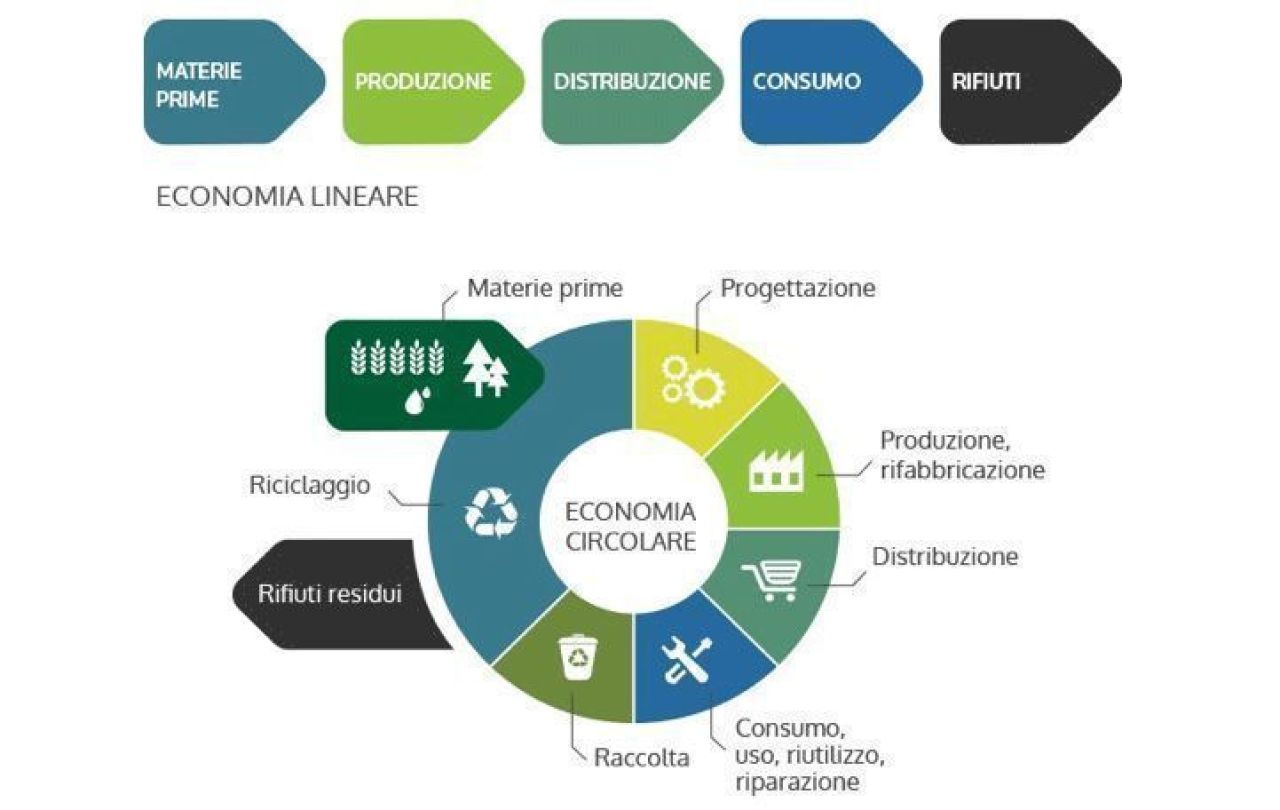
We have been hearing about the circular economy for many years without understanding what it means or rather how to apply it. Ordinary people think that it is simply about designing products to be recycled at the end of their life, but it is much more. We must be aware of the need to reduce the production of waste and the use of polluting substances, limit the consumption of materials and natural resources, maintain the existing environment in a sustainable way, compensate for greenhouse gas emissions and, finally, measure the effectiveness of our actions. In short, we need to reschedule and monitor our every activity.
From the website of the European Commission we learn that no less than 1,000,000,000.00 (one trillion) euros will be invested for the new development strategy in the countries of the European Union.
Climate change and environmental degradation are a huge threat to Europe and the world. To overcome these challenges, Europe needs a new growth strategy that transforms the Union into a modern, resource-efficient and competitive economy in which:
The European Green Deal is our roadmap to making the EU economy sustainable. We will achieve this goal by transforming climate issues and environmental challenges into opportunities across all policy sectors and making the transition fair and inclusive for all.
The European Green Deal includes an action plan aimed at:
The plan illustrates the necessary investments and available financing tools and explains how to ensure a fair and inclusive transition.
The EU intends to achieve climate neutrality in 2050. We have proposed a European Climate Law to turn this political commitment into a legal obligation.
Achieving this goal will require action from all sectors of our economy, including:
2020 has thrown the world into chaos that was long predicted, but hardly prepared for. Covid-19 has held a magnifying glass on the flaws of the global economy – flaws that have long been clear, but which society has continued to press the “silence” button.
For the first time ever, the amount of material consumed by our global economy also exceeded 100 billion tons, of which only 8.6% was recycled in the economy - a sober indicator of the progress we still have to make.
But if we've learned anything from 2020 so far, it's to "never let a crisis go to waste." The pandemic has created space on the global stage for the concept of “building back better.” This is an opportunity we must not miss.
We must therefore act with determination to accelerate the transition towards a circular economy and to guarantee a socially just and ecologically safe space for all. Below are some reflections on how circularity and resilience have become intimately linked to our activities and the broader ecosystem of actors we work with. We also look at the road ahead and what a system fit for an inclusive and resilient 21st century world might look like.
Rarely have the flaws of our global economy come together so prominently as under our collective experience of covid-19. Interdependent global supply chains, material extraction that occurs at a faster pace than remanufacturing, and an economic model focused on profit-making and endless growth at the expense of stability and resilience have been the hallmark of the "waste-taking" tradition. The pandemic has only served to draw the curtain on these defects.
Covid-19 has also had a disproportionate impact on low- and middle-income countries and minority groups within higher-income countries. These impacts have included increased rates of infection, deaths and job losses, highlighting entrenched inequalities in access to basic services such as clean water, healthcare, safe working conditions and social safety nets. The alarm has been raised once again to address systemic inequalities and it seems the world is finally listening that there is no environmental justice without social justice.
Now, the scale of the response must match that of the emergency. By engineering out waste and pollution, keeping products and materials in use, and regenerating natural systems, a circular economy allows us to collectively reimagine and redesign our systems to ensure an ecologically safe and socially just space for us all. A world where functioning social systems fall within healthy planetary boundaries. The circular economy now also has the opportunity and duty to further incorporate equality and resilience into this model.
Even before the pandemic, city officials and urban change makers have long been early adopters of the circular economy. It offers direction in reimagining cities that are resilient to future shocks and that strive for equality and access across the board. Now, mayors and leaders of the world's largest cities warn that there may be no return to business as usual as economies begin to rebuild.
But to translate the promise of the circular economy into practical, scalable action, they need guidance. Which strategies should be implemented and encouraged, in which sectors, together with which departments and why?
The city of Amsterdam has once again proven itself to be a cutting-edge circular city. Amsterdam's Circular Strategy 2020-2025 reinforces the city's plan to become fully circular by 2050. Integral to the plan is Doughnut Economics, a model developed by Oxford economist Kate Raworth, and scaled to meet the city's needs by different organisations. In this model it is clear that the circular economy is based on a healthy dynamic between social and ecological issues.
The pandemic has exposed the fragility inherent in many businesses and forced many to prioritize managing the immediate consequences of covid-19. But we've also seen a renewed focus on the importance of mitigating risk and building resilience across businesses of all sizes.
A circular business model is an integral part of adapting business to be fit for purpose in the 21st century. It is necessary to stimulate and support companies in building their capacity to embrace the changes necessary to move from a linear to a circular economic model.
There cannot be a global and circular transition without the commitment of countries: they have the mandate to develop national and international legislation and to create an environment conducive to the transition. As leading investors in infrastructure, government buildings and assets, their procurement strategy can also enable large-scale circularity. Now, the circular economy is increasingly at the forefront of sustainability strategies for countries around the world.
The Netherlands has embarked on a linear path in key sectors such as construction and agriculture, for example, and that a transformation is needed if the country is to reach the ambitious target of 100% circularity by 2050.
The pandemic has revealed the fragility and vulnerability of the current labor market, which revolves around maximizing efficiency and minimizing financial costs. It also highlighted key questions about how we value, think about and value work today, including the roles we consider vital to society.
The Circular Jobs Initiative (CJI) was launched in March this year by the Circle Economy to ensure the creation of a circular jobs market that allows both workers and the planet to thrive.
Because the circular economy relies on processes that require more labor than in the linear economy - where resources are often wasted or incinerated rather than repaired and reused - the transition is expected to be labor-intensive at first. This is an opportunity to promote decent and equal work and create new and more diverse skill sets and job roles.
HOW TO DO IT?
Times of global crises can bring about change. Before the pandemic hit, we were already at a social and economic crossroads. Calls for systemic transformation, away from the dominant capitalist and linear systems, were growing. The transition towards a circular system suitable for the world of the 21st century is therefore necessary, where production cannot continue to be the dominant principle of our relationship with the world.
Importantly, we are now armed with the knowledge that the economy can be held together comprehensively and simultaneously. This means it can change, specifically:
We must redefine prosperity: Growth for the sake of growth is not sustainable, nor does it take into account the well-being of human beings. A socially just space should aim to actively address society's endemic discrimination and racism that limits equality between groups. Ultimately, dominant social, economic and political power structures facilitate processes that benefit neither people nor the planet. A circular economy can aim to facilitate a system that does not perpetuate these same mistakes.
We must reintegrate with nature and the commons: Human beings have long found ways to arrange and manipulate nature. But every time we talk about the circular economy, we essentially invoke the emulation of nature. In the natural world, waste does not exist. Our industrial systems can mirror ecosystems, an increasingly important concept as raw material scarcity increases. Access to and conservation of common goods such as air and water are also key to this.
We need to balance the local and the global: increasingly ambiguous and complex value chains have long been criticized, but it took a pandemic to highlight how tragically fragile they are. Workers were left jobless or throwing goods that had been left to rot in the bin. Many healthcare workers were left without essential equipment. For some places, the pandemic has been a real-time experiment in downsizing the consumer economy, as imports and exports of both goods and people have been put on hold. As "normality" resumes, we can see a persevering notion of "globalization" that adapts to the local, but with an ethos of global cooperation.
FINDING A COMMON LANGUAGE
The circular economy has seen a notable increase in interest in recent years and continues to gain a steady pace.
With this surge in popularity, many mention the term "circular economy" or "circular principles" without really explaining what they mean. On the other hand, if the term is defined, the definition varies widely depending on the problems addressed, the audience, or the lens through which the author views the world.
To define a common language for the circular economy, Circle Economy has mapped the various terms and definitions used by over 20 organizations - NGOs, government agencies, universities, consultancies, etc. - working on elements of the topic. After interpreting and grouping these various terms, seven key elements emerged that defined most of the terms related to the circular economy.
2. Incorporate digital technology
3. Preserve and extend the existing
4. Prioritize regenerative resources
6. Rethinking the Business Model
7. Collaborate to create common value
The blind points of the circular economy
Having today the technology and the POWERgrass method that allows us to accurately manage all phases of a green area, there are no excuses for investors on how the fields of the future should be created and maintained. We can all contribute to the development of a circular economy with a positive environmental impact by preserving soil erosion, sequestering carbon in the soil and without polluting.
POWERgrass is a system studied holistically, in collaboration with multidisciplinary experts, to offer a reinforced natural grass playing field designed for professionals that also meets the needs of amateurs.
We have been hearing about the circular economy for many years without understanding what it means or rather how to apply it. Ordinary people think that it is simply about designing products to be recycled at the end of their life, but it is much more. We must be aware of the need to reduce the production of waste and the use of polluting substances, limit the consumption of materials and natural resources, maintain the existing environment in a sustainable way, compensate for greenhouse gas emissions and, finally, measure the effectiveness of our actions. In short, we need to reschedule and monitor our every activity.
From the website of the European Commission we learn that no less than 1,000,000,000.00 (one trillion) euros will be invested for the new development strategy in the countries of the European Union.
Climate change and environmental degradation are a huge threat to Europe and the world. To overcome these challenges, Europe needs a new growth strategy that transforms the Union into a modern, resource-efficient and competitive economy in which:
The European Green Deal is our roadmap to making the EU economy sustainable. We will achieve this goal by transforming climate issues and environmental challenges into opportunities across all policy sectors and making the transition fair and inclusive for all.
The European Green Deal includes an action plan aimed at:
The plan illustrates the necessary investments and available financing tools and explains how to ensure a fair and inclusive transition.
The EU intends to achieve climate neutrality in 2050. We have proposed a European Climate Law to turn this political commitment into a legal obligation.
Achieving this goal will require action from all sectors of our economy, including:
2020 has thrown the world into chaos that was long predicted, but hardly prepared for. Covid-19 has held a magnifying glass on the flaws of the global economy – flaws that have long been clear, but which society has continued to press the “silence” button.
For the first time ever, the amount of material consumed by our global economy also exceeded 100 billion tons, of which only 8.6% was recycled in the economy - a sober indicator of the progress we still have to make.
But if we've learned anything from 2020 so far, it's to "never let a crisis go to waste." The pandemic has created space on the global stage for the concept of “building back better.” This is an opportunity we must not miss.
We must therefore act with determination to accelerate the transition towards a circular economy and to guarantee a socially just and ecologically safe space for all. Below are some reflections on how circularity and resilience have become intimately linked to our activities and the broader ecosystem of actors we work with. We also look at the road ahead and what a system fit for an inclusive and resilient 21st century world might look like.
Rarely have the flaws of our global economy come together so prominently as under our collective experience of covid-19. Interdependent global supply chains, material extraction that occurs at a faster pace than remanufacturing, and an economic model focused on profit-making and endless growth at the expense of stability and resilience have been the hallmark of the "waste-taking" tradition. The pandemic has only served to draw the curtain on these defects.
Covid-19 has also had a disproportionate impact on low- and middle-income countries and minority groups within higher-income countries. These impacts have included increased rates of infection, deaths and job losses, highlighting entrenched inequalities in access to basic services such as clean water, healthcare, safe working conditions and social safety nets. The alarm has been raised once again to address systemic inequalities and it seems the world is finally listening that there is no environmental justice without social justice.
Now, the scale of the response must match that of the emergency. By engineering out waste and pollution, keeping products and materials in use, and regenerating natural systems, a circular economy allows us to collectively reimagine and redesign our systems to ensure an ecologically safe and socially just space for us all. A world where functioning social systems fall within healthy planetary boundaries. The circular economy now also has the opportunity and duty to further incorporate equality and resilience into this model.
Even before the pandemic, city officials and urban change makers have long been early adopters of the circular economy. It offers direction in reimagining cities that are resilient to future shocks and that strive for equality and access across the board. Now, mayors and leaders of the world's largest cities warn that there may be no return to business as usual as economies begin to rebuild.
But to translate the promise of the circular economy into practical, scalable action, they need guidance. Which strategies should be implemented and encouraged, in which sectors, together with which departments and why?
The city of Amsterdam has once again proven itself to be a cutting-edge circular city. Amsterdam's Circular Strategy 2020-2025 reinforces the city's plan to become fully circular by 2050. Integral to the plan is Doughnut Economics, a model developed by Oxford economist Kate Raworth, and scaled to meet the city's needs by different organisations. In this model it is clear that the circular economy is based on a healthy dynamic between social and ecological issues.
The pandemic has exposed the fragility inherent in many businesses and forced many to prioritize managing the immediate consequences of covid-19. But we've also seen a renewed focus on the importance of mitigating risk and building resilience across businesses of all sizes.
A circular business model is an integral part of adapting business to be fit for purpose in the 21st century. It is necessary to stimulate and support companies in building their capacity to embrace the changes necessary to move from a linear to a circular economic model.
There cannot be a global and circular transition without the commitment of countries: they have the mandate to develop national and international legislation and to create an environment conducive to the transition. As leading investors in infrastructure, government buildings and assets, their procurement strategy can also enable large-scale circularity. Now, the circular economy is increasingly at the forefront of sustainability strategies for countries around the world.
The Netherlands has embarked on a linear path in key sectors such as construction and agriculture, for example, and that a transformation is needed if the country is to reach the ambitious target of 100% circularity by 2050.
The pandemic has revealed the fragility and vulnerability of the current labor market, which revolves around maximizing efficiency and minimizing financial costs. It also highlighted key questions about how we value, think about and value work today, including the roles we consider vital to society.
The Circular Jobs Initiative (CJI) was launched in March this year by the Circle Economy to ensure the creation of a circular jobs market that allows both workers and the planet to thrive.
Because the circular economy relies on processes that require more labor than in the linear economy - where resources are often wasted or incinerated rather than repaired and reused - the transition is expected to be labor-intensive at first. This is an opportunity to promote decent and equal work and create new and more diverse skill sets and job roles.
HOW TO DO IT?
Times of global crises can bring about change. Before the pandemic hit, we were already at a social and economic crossroads. Calls for systemic transformation, away from the dominant capitalist and linear systems, were growing. The transition towards a circular system suitable for the world of the 21st century is therefore necessary, where production cannot continue to be the dominant principle of our relationship with the world.
Importantly, we are now armed with the knowledge that the economy can be held together comprehensively and simultaneously. This means it can change, specifically:
We must redefine prosperity: Growth for the sake of growth is not sustainable, nor does it take into account the well-being of human beings. A socially just space should aim to actively address society's endemic discrimination and racism that limits equality between groups. Ultimately, dominant social, economic and political power structures facilitate processes that benefit neither people nor the planet. A circular economy can aim to facilitate a system that does not perpetuate these same mistakes.
We must reintegrate with nature and the commons: Human beings have long found ways to arrange and manipulate nature. But every time we talk about the circular economy, we essentially invoke the emulation of nature. In the natural world, waste does not exist. Our industrial systems can mirror ecosystems, an increasingly important concept as raw material scarcity increases. Access to and conservation of common goods such as air and water are also key to this.
We need to balance the local and the global: increasingly ambiguous and complex value chains have long been criticized, but it took a pandemic to highlight how tragically fragile they are. Workers were left jobless or throwing goods that had been left to rot in the bin. Many healthcare workers were left without essential equipment. For some places, the pandemic has been a real-time experiment in downsizing the consumer economy, as imports and exports of both goods and people have been put on hold. As "normality" resumes, we can see a persevering notion of "globalization" that adapts to the local, but with an ethos of global cooperation.
FINDING A COMMON LANGUAGE
The circular economy has seen a notable increase in interest in recent years and continues to gain a steady pace.
With this surge in popularity, many mention the term "circular economy" or "circular principles" without really explaining what they mean. On the other hand, if the term is defined, the definition varies widely depending on the problems addressed, the audience, or the lens through which the author views the world.
To define a common language for the circular economy, Circle Economy has mapped the various terms and definitions used by over 20 organizations - NGOs, government agencies, universities, consultancies, etc. - working on elements of the topic. After interpreting and grouping these various terms, seven key elements emerged that defined most of the terms related to the circular economy.
2. Incorporate digital technology
3. Preserve and extend the existing
4. Prioritize regenerative resources
6. Rethinking the Business Model
7. Collaborate to create common value
The blind points of the circular economy
Having today the technology and the POWERgrass method that allows us to accurately manage all phases of a green area, there are no excuses for investors on how the fields of the future should be created and maintained. We can all contribute to the development of a circular economy with a positive environmental impact by preserving soil erosion, sequestering carbon in the soil and without polluting.
POWERgrass is a system studied holistically, in collaboration with multidisciplinary experts, to offer a reinforced natural grass playing field designed for professionals that also meets the needs of amateurs.