Natural grass reinforcement

  • Published 28/02/2024   Focus on
  •  by POWERgrass

The innovative POWERgrass hybrid lawn versus old generation hybrid lawns: definition and comparison of limits and advantages.
The demand for hybrid lawns is continually increasing, therefore it is good to provide a clear definition and differentiate hybrid lawns from reinforced natural grass systems.

By analyzing the etymology of the words we can well understand that reinforced natural grass means: the set of methods that use synthetic products (microfibres, elastic fibres, mesh mixed in the vegetal growth substrate, green synthetic fibers implanted in the vegetal growth substrate and synthetic grass integrated into the vegetal growth substrate) to reinforce the natural grass.

Within this category there are therefore also synthetic grass surfaces which are clogged with vegetal growth substrate where the natural grass grows in the space between the synthetic fibres. In most cases, these coverings include an ad hoc support (backing) which, at least from a theoretical point of view, should allow the roots to pass through to also grow in the vegetal growth substrate under the backing. In short, natural grass grows and thrives within a synthetic turf.

Many therefore define this mixed grass as "hybrid lawn", but it is good to take a step forward to better understand what it really is. Analyzing the etymology of the word hybrid, from an agronomic point of view, this term would be improper because there would have to be a genetic "fusion" and this is impossible.

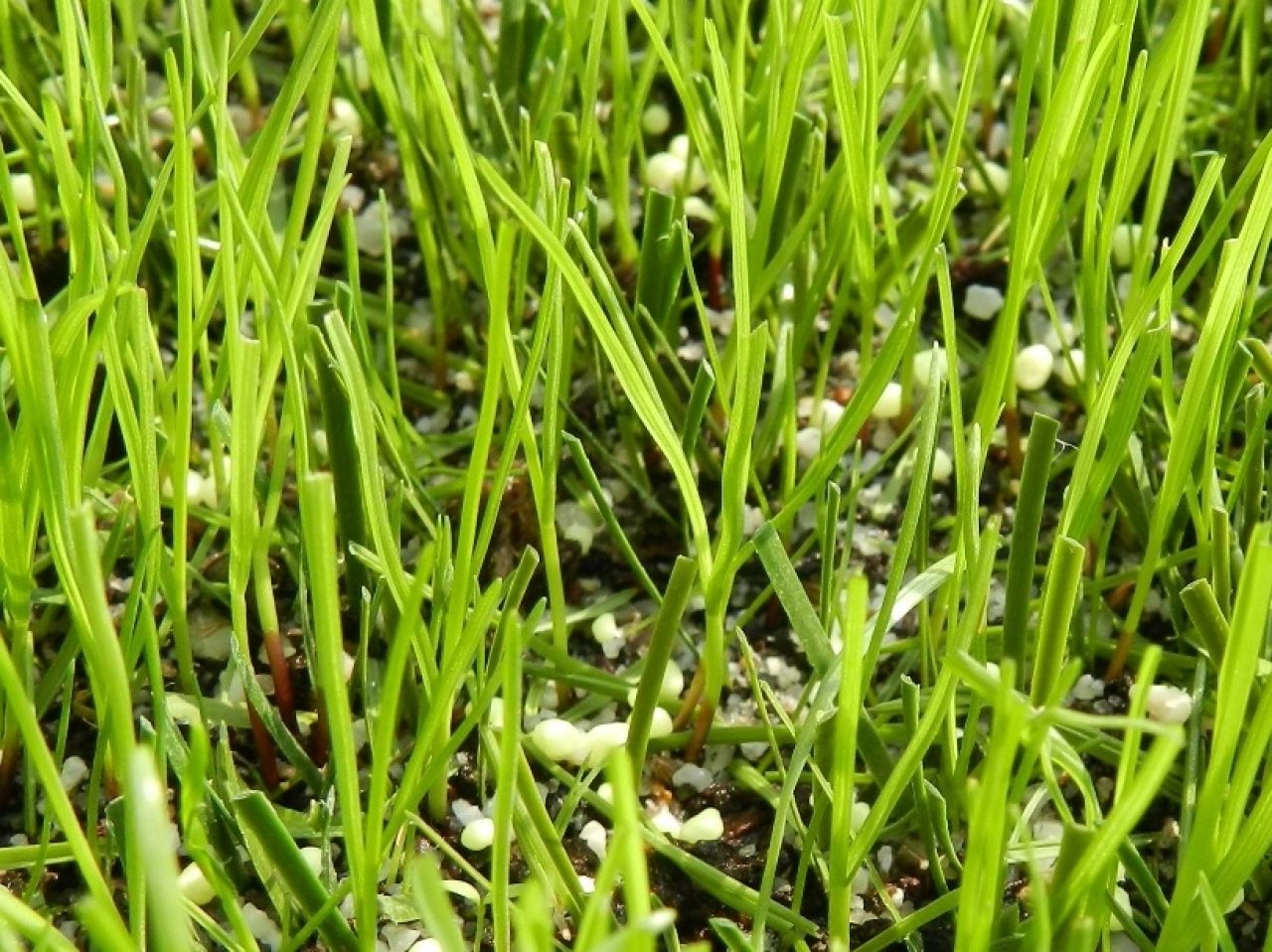
Natural grass grows between synthetic fibers

Therefore, considering the mutual advantages that these systems offer between natural grass and synthetic grass, we can say that it is a symbiosis and therefore it would be right to provide a scientific definition of "mixed lawn in symbiosis" or "mixed grass in symbiosis".

However, taking inspiration from the automotive sector, the term hybrid is conventionally accepted as a car powered by two different energy sources such as petrol and electricity. Drawing a parallel in the sports fields sector, we can define a "hybrid lawn" as a mixed, natural and synthetic grass where you can play alternatively with or without natural grass.

This also coincides with market demand and is the concern of many who use the playing field in an extreme way. In short, by establishing a new market standard we can define that thehybrid lawn is the system that provides the adequate conditions for the growth of natural grass from the beginning and a playable field even in those cases in which, for any reason (extreme use, weather conditions or human error), the natural grass could possibly be damaged.

The POWERgrass hybrid lawn has innovative characteristics and offers better playing and growing conditions than any other reinforced natural grass system or old hybrid lawn system and at the same time offers a sports field that can be played even without natural grass. Synthetic grass is stable and natural grass can be easily installed with simple planting.
Strengthening natural grass is not that simple; it is necessary to respect the laws of nature, therefore favoring gas exchange in the plant substrate and keeping its density within 1300 kg/m3

Hybrid lawns are nothing new! The first system was developed in the United States in 1993. It immediately seemed like a brilliant idea, but it had limited diffusion for a few reasons, let's examine them:

  1. difficulty in fixing the synthetic fibers to the open backing :
    • the roots provide support to the natural grass, they absorb water and fertilizer in the soil and to carry out their function both they and the bacteria useful for mineralising the nutritional elements need to breathe; having to let the roots breathe and stimulate development in depth, even under the backing, it was not possible to use the classic (closed) polypropylene (PP) fabric and the latex (SBR) or polyurethane (PU) coating, necessary to fix the fibers to the support in the case of traditional synthetic grass; in fact, the industry has tried to block the synthetic grass fibers in a specifically designed, partially biodegradable fabric, which over time should have partially decomposed, forming numerous spaces for the roots to penetrate the support and make them grow underneath, in the plant substrate; in reality, decomposition does not occur in time, compatible with the needs of natural grass for rapid establishment, as it depends on numerous technological and environmental factors;
    • in most synthetic grass buildings for hybrid systems, the fixing of the synthetic grass fibers is weak and over time partial degradation of the support risks further loosening the fixing of the synthetic grass fibers to the support, so the natural grass simply remains anchored to the net; the fibers of the synthetic grass do not contribute to stability and when the natural grass is weak, or very worn, it gives way and together with the clods of the natural grass, the fibers of the synthetic grass are also removed together with the vegetal substrate, uncovering the fabric, so the work must be done from scratch;
      Attention! Some companies, even today, offer a fabric for hybrid turfs lightly fixing the synthetic grass fibers to the mesh with holding values lower than 30 N; the synthetic grass produced in this way is incomplete therefore during clogging with the infill material it is not possible to intensively brush the synthetic grass therefore lift the synthetic grass fibers which must necessarily protrude at least 15-20 mm beyond the substrate vegetable; in fact, we often observe the synthetic grass fibers buried in the plant substrate and they do not perform any function of protecting the crown of the natural grass and the only plausible reinforcement is the fact that the roots can anchor themselves on the synthetic grass net;
  2. unfavorable natural grass growing conditions:
    • in some cases, during the first growth period, the roots do not penetrate the synthetic grass support (backing) until it partially degrades; in the meantime, they develop horizontally above the backing contributing to the formation of thatch; to support the growth of natural grass from a water point of view, one is forced to water often and consequently the roots remain "nicely comfortable" on the surface above the backing: it is known that a lawn in these conditions cannot resist the stress of intensive trampling,
    • in some cases, the excess humidity associated with a rich biological activity consumes oxygen (O2) in the soil, starting an anaerobic activity that consumes oxygen from water (H2O) and sulfur oxides (SO2 and SO3), thus releasing hydrogen (H) and elemental sulfur (S); the latter form a very powerful acid, a toxic poison, hydrogen sulfide (H2S) characterized by the characteristic smell of rotten eggs; the persistence of these conditions causes irreversible intoxication of the natural grass which becomes red, without roots and dies;
    • some companies fix the synthetic grass fibers to the backing, spreading a liquid glue over the entire surface or using one of the classic methods for entirely synthetic grass, i.e. the use of latex, polyurethane, or thermoplastic and have a "high" number of holes to facilitate the passage of the roots; in truth the roots do not pass through, due to the fact that the number of holes is limited and above all because said backing is flat and smooth: the spaces between the various holes are impermeable, therefore the water deposited above the backing forms an "invisible water barrier", due to the surface tension of the water which obstructs the gaseous exchange and consequently the growth conditions for the roots are not favorable under the backing; another plausible explanation is the fact that the water deposited above the backing contributes to retaining an excess of humidity in the rhizosphere above the backing, intensifying the intoxication phenomenon with the formation of hydrogen sulphide (H2S).
  3. excessively hard playing field surface:
    • over the years we have always tried to integrate the synthetic grass with the sand vegetal substrate following the USGA standards; sand is a material that forms a highly porous growth substrate, approximately 35% (10% micro-pores and 25% macro-pores), even when compacted it is permeable to water, but after a certain number of hours of play the playing surface becomes hard both for the players but also for the development of the roots and the playing field requires intervention with the Verti-Drain to break up the sand plant substrate;
    • by mixing or deeply implanting synthetic fibers in the sand plant substrate, the hardness of the bottom increases and requires more frequent interventions with Verti-Drain;
    • in some cases, the application of an open warp and weft fabric forms a very compact surface underneath it and the roots find greater resistance and no longer penetrate the sand plant substrate and if nothing is done, the playing field also hardens in the superficial part and the natural lawn tends to thin out;
    • in some cases, the application of an excessively open net favors the penetration of sand into the mesh of the net, partially obstructs the holes and hardens the support; in fact, the horizontal tension of the net contributes to the vertical compression caused by the players and the transit of maintenance machines; the hardening in the backing area is perceived excessively on the surface by the player and at the same time the natural grass roots encounter excessive mechanical resistance precisely because the net is partially blocked and hardened.

POWERgrass®, product and method: the solution approach to the problem

The search for the solution to the problems previously examined led to a long study to understand in depth the merits and defects of the artificial turf and the vegetal substrate.

After a long study and direct experience in the field that characterizes the partners involved in the POWERgrass group, we understood that it is essential to develop an indivisible set of essential characteristics to create the ideal hybrid grass system:

  1. use robust and resilient synthetic fibres to maintain an upright position above the decking and truly protect the crown of the natural grass;
  2. welding the synthetic grass fibers well to a breathable support without blocking its porosity is also a must in order to clog the synthetic turf with the sandy growth substrate, brushing and harrowing its fibers so that they protrude 20-30 mm above the surface and protect the crown of the natural grass; during subsequent maintenance it is therefore possible to remove the felt (scarify with tongs) or all the natural grass (re-turfing) without damaging the synthetic fibres;
  3. use a support (backing) for the synthetic surface, non-biodegradable, open, with a three-dimensional structure, therefore breathable evenly over the entire surface; in detail there are further aspects that characterize the support of synthetic grass, equally essential to offer an ideal system for playing and for the growth of natural grass, such as:
    • the support must be soft and flexible at each intersection between the holes, to allow better interaction of the player's cleat with the flooring and avoid hardening of the surface;
    • the support must have high porosity due to over 160,000 interconnected holes which, thanks to the three-dimensional structure, prevent water stagnation above the surface and allow gas exchange; at the same time, the size and shape of the holes is such as to a) allow the penetration of the roots from the beginning of the growth of the natural grass, therefore reinforcing the anchoring of the grass clod which drastically increases the resistance to tearing caused by sliding players and b) preventing the passage of sand, to keep the internal structure of the support open and soft;
    • finally, the support must be warp-knitted thanks to its fibers knotted at each crossing therefore it is not possible to undo its weave following multiple hole-punching operations necessary to break up and aerate the sandy plant substrate under the support.

All these characteristics form the ideal building for an excellent hybrid system, more unique than rare on a global level, protected by 3 international patent applications.

ZOEsand, the elementary soil improver for the POWERgras method

An excellent hybrid system also requires a ad hoc plant substrate to optimize sports performance, the growth conditions of the natural grass and the development of the roots above and below the support (backing).

ZOEsand is the result of long research and intuition thanks to a profound knowledge of the two worlds: that of natural grass and artificial grass.

The ZOEsand increases the porosity and moisture retained in the sandy growing substrate, provides its insulating properties to reduce extreme temperature variations in the rhizosphere during summer heat and winter frost, provides a shock absorbing effect in the sports surface, reduces soil compaction and density apparentof the growth substrate.

Identifying the suitable mixture for growing natural grass in a hybrid lawn system was not easy; over 2 years of study and testing of all possible combinations with the mixtures available on the market were necessary. Today the results amaze the best scholars in the world.

Thanks to this research, a special sand mixture was formulated based on USGA prescriptions, with an organic vegetal substrate: ZOEsand, a perfect patent to integrate into hybrid lawns.

The ZOEsand soil improver contains coconut peat, the finest cork and zeolite sand. Integrating ZOEsand into the growth substrate is equally important to improve performance, resistance and durability, drastically reducing maintenance costs.

  • coco peat will retain moisture and generate humus in the growing medium to provide carbon to microorganisms for a long period;
  • zeolite sand will increase soil fertility, increasing CSC (Cation Exchange Capacity);
  • gentle cork is stable above 60% for approximately 100 years and is used to balance the temperature and air/water content in the growing substrate, reduce compaction and provide a softer playing surface;

  Tags 

Natural grass reinforcement

fa20-20sviluppo20iniziale20RID1

The innovative POWERgrass hybrid lawn versus old generation hybrid lawns: definition and comparison of limits and advantages.

  • 28/02/2024
  • Italgreen Landscape

The demand for hybrid lawns is continually increasing, therefore it is good to provide a clear definition and differentiate hybrid lawns from reinforced natural grass systems.

By analyzing the etymology of the words we can well understand that reinforced natural grass means: the set of methods that use synthetic products (microfibres, elastic fibres, mesh mixed in the vegetal growth substrate, green synthetic fibers implanted in the vegetal growth substrate and synthetic grass integrated into the vegetal growth substrate) to reinforce the natural grass.

Within this category there are therefore also synthetic grass surfaces which are clogged with vegetal growth substrate where the natural grass grows in the space between the synthetic fibres. In most cases, these coverings include an ad hoc support (backing) which, at least from a theoretical point of view, should allow the roots to pass through to also grow in the vegetal growth substrate under the backing. In short, natural grass grows and thrives within a synthetic turf.

Many therefore define this mixed grass as "hybrid lawn", but it is good to take a step forward to better understand what it really is. Analyzing the etymology of the word hybrid, from an agronomic point of view, this term would be improper because there would have to be a genetic "fusion" and this is impossible.

Natural grass grows between synthetic fibers

Therefore, considering the mutual advantages that these systems offer between natural grass and synthetic grass, we can say that it is a symbiosis and therefore it would be right to provide a scientific definition of "mixed lawn in symbiosis" or "mixed grass in symbiosis".

However, taking inspiration from the automotive sector, the term hybrid is conventionally accepted as a car powered by two different energy sources such as petrol and electricity. Drawing a parallel in the sports fields sector, we can define a "hybrid lawn" as a mixed, natural and synthetic grass where you can play alternatively with or without natural grass.

This also coincides with market demand and is the concern of many who use the playing field in an extreme way. In short, by establishing a new market standard we can define that thehybrid lawn is the system that provides the adequate conditions for the growth of natural grass from the beginning and a playable field even in those cases in which, for any reason (extreme use, weather conditions or human error), the natural grass could possibly be damaged.

The POWERgrass hybrid lawn has innovative characteristics and offers better playing and growing conditions than any other reinforced natural grass system or old hybrid lawn system and at the same time offers a sports field that can be played even without natural grass. Synthetic grass is stable and natural grass can be easily installed with simple planting.

Strengthening natural grass is not that simple; it is necessary to respect the laws of nature, therefore favoring gas exchange in the plant substrate and keeping its density within 1300 kg/m3

Hybrid lawns are nothing new! The first system was developed in the United States in 1993. It immediately seemed like a brilliant idea, but it had limited diffusion for a few reasons, let's examine them:

  1. difficulty in fixing the synthetic fibers to the open backing :
    • the roots provide support to the natural grass, they absorb water and fertilizer in the soil and to carry out their function both they and the bacteria useful for mineralising the nutritional elements need to breathe; having to let the roots breathe and stimulate development in depth, even under the backing, it was not possible to use the classic (closed) polypropylene (PP) fabric and the latex (SBR) or polyurethane (PU) coating, necessary to fix the fibers to the support in the case of traditional synthetic grass; in fact, the industry has tried to block the synthetic grass fibers in a specifically designed, partially biodegradable fabric, which over time should have partially decomposed, forming numerous spaces for the roots to penetrate the support and make them grow underneath, in the plant substrate; in reality, decomposition does not occur in time, compatible with the needs of natural grass for rapid establishment, as it depends on numerous technological and environmental factors;
    • in most synthetic grass buildings for hybrid systems, the fixing of the synthetic grass fibers is weak and over time partial degradation of the support risks further loosening the fixing of the synthetic grass fibers to the support, so the natural grass simply remains anchored to the net; the fibers of the synthetic grass do not contribute to stability and when the natural grass is weak, or very worn, it gives way and together with the clods of the natural grass, the fibers of the synthetic grass are also removed together with the vegetal substrate, uncovering the fabric, so the work must be done from scratch;
      Attention! Some companies, even today, offer a fabric for hybrid turfs lightly fixing the synthetic grass fibers to the mesh with holding values lower than 30 N; the synthetic grass produced in this way is incomplete therefore during clogging with the infill material it is not possible to intensively brush the synthetic grass therefore lift the synthetic grass fibers which must necessarily protrude at least 15-20 mm beyond the substrate vegetable; in fact, we often observe the synthetic grass fibers buried in the plant substrate and they do not perform any function of protecting the crown of the natural grass and the only plausible reinforcement is the fact that the roots can anchor themselves on the synthetic grass net;
  2. unfavorable natural grass growing conditions:
    • in some cases, during the first growth period, the roots do not penetrate the synthetic grass support (backing) until it partially degrades; in the meantime, they develop horizontally above the backing contributing to the formation of thatch; to support the growth of natural grass from a water point of view, one is forced to water often and consequently the roots remain "nicely comfortable" on the surface above the backing: it is known that a lawn in these conditions cannot resist the stress of intensive trampling,
    • in some cases, the excess humidity associated with a rich biological activity consumes oxygen (O2) in the soil, starting an anaerobic activity that consumes oxygen from water (H2O) and sulfur oxides (SO2 and SO3), thus releasing hydrogen (H) and elemental sulfur (S); the latter form a very powerful acid, a toxic poison, hydrogen sulfide (H2S) characterized by the characteristic smell of rotten eggs; the persistence of these conditions causes irreversible intoxication of the natural grass which becomes red, without roots and dies;
    • some companies fix the synthetic grass fibers to the backing, spreading a liquid glue over the entire surface or using one of the classic methods for entirely synthetic grass, i.e. the use of latex, polyurethane, or thermoplastic and have a "high" number of holes to facilitate the passage of the roots; in truth the roots do not pass through, due to the fact that the number of holes is limited and above all because said backing is flat and smooth: the spaces between the various holes are impermeable, therefore the water deposited above the backing forms an "invisible water barrier", due to the surface tension of the water which obstructs the gaseous exchange and consequently the growth conditions for the roots are not favorable under the backing; another plausible explanation is the fact that the water deposited above the backing contributes to retaining an excess of humidity in the rhizosphere above the backing, intensifying the intoxication phenomenon with the formation of hydrogen sulphide (H2S).
  3. excessively hard playing field surface:
    • over the years we have always tried to integrate the synthetic grass with the sand vegetal substrate following the USGA standards; sand is a material that forms a highly porous growth substrate, approximately 35% (10% micro-pores and 25% macro-pores), even when compacted it is permeable to water, but after a certain number of hours of play the playing surface becomes hard both for the players but also for the development of the roots and the playing field requires intervention with the Verti-Drain to break up the sand plant substrate;
    • by mixing or deeply implanting synthetic fibers in the sand plant substrate, the hardness of the bottom increases and requires more frequent interventions with Verti-Drain;
    • in some cases, the application of an open warp and weft fabric forms a very compact surface underneath it and the roots find greater resistance and no longer penetrate the sand plant substrate and if nothing is done, the playing field also hardens in the superficial part and the natural lawn tends to thin out;
    • in some cases, the application of an excessively open net favors the penetration of sand into the mesh of the net, partially obstructs the holes and hardens the support; in fact, the horizontal tension of the net contributes to the vertical compression caused by the players and the transit of maintenance machines; the hardening in the backing area is perceived excessively on the surface by the player and at the same time the natural grass roots encounter excessive mechanical resistance precisely because the net is partially blocked and hardened.

POWERgrass®, product and method: the solution approach to the problem

The search for the solution to the problems previously examined led to a long study to understand in depth the merits and defects of the artificial turf and the vegetal substrate.

After a long study and direct experience in the field that characterizes the partners involved in the POWERgrass group, we understood that it is essential to develop an indivisible set of essential characteristics to create the ideal hybrid grass system:

  1. use robust and resilient synthetic fibres to maintain an upright position above the decking and truly protect the crown of the natural grass;
  2. welding the synthetic grass fibers well to a breathable support without blocking its porosity is also a must in order to clog the synthetic turf with the sandy growth substrate, brushing and harrowing its fibers so that they protrude 20-30 mm above the surface and protect the crown of the natural grass; during subsequent maintenance it is therefore possible to remove the felt (scarify with tongs) or all the natural grass (re-turfing) without damaging the synthetic fibres;
  3. use a support (backing) for the synthetic surface, non-biodegradable, open, with a three-dimensional structure, therefore breathable evenly over the entire surface; in detail there are further aspects that characterize the support of synthetic grass, equally essential to offer an ideal system for playing and for the growth of natural grass, such as:
    • the support must be soft and flexible at each intersection between the holes, to allow better interaction of the player's cleat with the flooring and avoid hardening of the surface;
    • the support must have high porosity due to over 160,000 interconnected holes which, thanks to the three-dimensional structure, prevent water stagnation above the surface and allow gas exchange; at the same time, the size and shape of the holes is such as to a) allow the penetration of the roots from the beginning of the growth of the natural grass, therefore reinforcing the anchoring of the grass clod which drastically increases the resistance to tearing caused by sliding players and b) preventing the passage of sand, to keep the internal structure of the support open and soft;
    • finally, the support must be warp-knitted thanks to its fibers knotted at each crossing therefore it is not possible to undo its weave following multiple hole-punching operations necessary to break up and aerate the sandy plant substrate under the support.

All these characteristics form the ideal building for an excellent hybrid system, more unique than rare on a global level, protected by 3 international patent applications.

ZOEsand, the elementary soil improver for the POWERgras method

An excellent hybrid system also requires a ad hoc plant substrate to optimize sports performance, the growth conditions of the natural grass and the development of the roots above and below the support (backing).

ZOEsand is the result of long research and intuition thanks to a profound knowledge of the two worlds: that of natural grass and artificial grass.

The ZOEsand increases the porosity and moisture retained in the sandy growing substrate, provides its insulating properties to reduce extreme temperature variations in the rhizosphere during summer heat and winter frost, provides a shock absorbing effect in the sports surface, reduces soil compaction and density apparentof the growth substrate.

Identifying the suitable mixture for growing natural grass in a hybrid lawn system was not easy; over 2 years of study and testing of all possible combinations with the mixtures available on the market were necessary. Today the results amaze the best scholars in the world.

Thanks to this research, a special sand mixture was formulated based on USGA prescriptions, with an organic vegetal substrate: ZOEsand, a perfect patent to integrate into hybrid lawns.

The ZOEsand soil improver contains coconut peat, the finest cork and zeolite sand. Integrating ZOEsand into the growth substrate is equally important to improve performance, resistance and durability, drastically reducing maintenance costs.

  • coco peat will retain moisture and generate humus in the growing medium to provide carbon to microorganisms for a long period;
  • zeolite sand will increase soil fertility, increasing CSC (Cation Exchange Capacity);
  • gentle cork is stable above 60% for approximately 100 years and is used to balance the temperature and air/water content in the growing substrate, reduce compaction and provide a softer playing surface;

Condividi su

Categorie

Tags

Archivio


Natural grass reinforcement

Focus on / 28/02/2024

The innovative POWERgrass hybrid lawn versus old generation hybrid lawns: definition and comparison of limits and advantages.

The demand for hybrid lawns is continually increasing, therefore it is good to provide a clear definition and differentiate hybrid lawns from reinforced natural grass systems.

By analyzing the etymology of the words we can well understand that reinforced natural grass means: the set of methods that use synthetic products (microfibres, elastic fibres, mesh mixed in the vegetal growth substrate, green synthetic fibers implanted in the vegetal growth substrate and synthetic grass integrated into the vegetal growth substrate) to reinforce the natural grass.

Within this category there are therefore also synthetic grass surfaces which are clogged with vegetal growth substrate where the natural grass grows in the space between the synthetic fibres. In most cases, these coverings include an ad hoc support (backing) which, at least from a theoretical point of view, should allow the roots to pass through to also grow in the vegetal growth substrate under the backing. In short, natural grass grows and thrives within a synthetic turf.

Many therefore define this mixed grass as "hybrid lawn", but it is good to take a step forward to better understand what it really is. Analyzing the etymology of the word hybrid, from an agronomic point of view, this term would be improper because there would have to be a genetic "fusion" and this is impossible.

Natural grass grows between synthetic fibers

Therefore, considering the mutual advantages that these systems offer between natural grass and synthetic grass, we can say that it is a symbiosis and therefore it would be right to provide a scientific definition of "mixed lawn in symbiosis" or "mixed grass in symbiosis".

However, taking inspiration from the automotive sector, the term hybrid is conventionally accepted as a car powered by two different energy sources such as petrol and electricity. Drawing a parallel in the sports fields sector, we can define a "hybrid lawn" as a mixed, natural and synthetic grass where you can play alternatively with or without natural grass.

This also coincides with market demand and is the concern of many who use the playing field in an extreme way. In short, by establishing a new market standard we can define that thehybrid lawn is the system that provides the adequate conditions for the growth of natural grass from the beginning and a playable field even in those cases in which, for any reason (extreme use, weather conditions or human error), the natural grass could possibly be damaged.

The POWERgrass hybrid lawn has innovative characteristics and offers better playing and growing conditions than any other reinforced natural grass system or old hybrid lawn system and at the same time offers a sports field that can be played even without natural grass. Synthetic grass is stable and natural grass can be easily installed with simple planting.

Strengthening natural grass is not that simple; it is necessary to respect the laws of nature, therefore favoring gas exchange in the plant substrate and keeping its density within 1300 kg/m3

Hybrid lawns are nothing new! The first system was developed in the United States in 1993. It immediately seemed like a brilliant idea, but it had limited diffusion for a few reasons, let's examine them:

  1. difficulty in fixing the synthetic fibers to the open backing :
    • the roots provide support to the natural grass, they absorb water and fertilizer in the soil and to carry out their function both they and the bacteria useful for mineralising the nutritional elements need to breathe; having to let the roots breathe and stimulate development in depth, even under the backing, it was not possible to use the classic (closed) polypropylene (PP) fabric and the latex (SBR) or polyurethane (PU) coating, necessary to fix the fibers to the support in the case of traditional synthetic grass; in fact, the industry has tried to block the synthetic grass fibers in a specifically designed, partially biodegradable fabric, which over time should have partially decomposed, forming numerous spaces for the roots to penetrate the support and make them grow underneath, in the plant substrate; in reality, decomposition does not occur in time, compatible with the needs of natural grass for rapid establishment, as it depends on numerous technological and environmental factors;
    • in most synthetic grass buildings for hybrid systems, the fixing of the synthetic grass fibers is weak and over time partial degradation of the support risks further loosening the fixing of the synthetic grass fibers to the support, so the natural grass simply remains anchored to the net; the fibers of the synthetic grass do not contribute to stability and when the natural grass is weak, or very worn, it gives way and together with the clods of the natural grass, the fibers of the synthetic grass are also removed together with the vegetal substrate, uncovering the fabric, so the work must be done from scratch;
      Attention! Some companies, even today, offer a fabric for hybrid turfs lightly fixing the synthetic grass fibers to the mesh with holding values lower than 30 N; the synthetic grass produced in this way is incomplete therefore during clogging with the infill material it is not possible to intensively brush the synthetic grass therefore lift the synthetic grass fibers which must necessarily protrude at least 15-20 mm beyond the substrate vegetable; in fact, we often observe the synthetic grass fibers buried in the plant substrate and they do not perform any function of protecting the crown of the natural grass and the only plausible reinforcement is the fact that the roots can anchor themselves on the synthetic grass net;
  2. unfavorable natural grass growing conditions:
    • in some cases, during the first growth period, the roots do not penetrate the synthetic grass support (backing) until it partially degrades; in the meantime, they develop horizontally above the backing contributing to the formation of thatch; to support the growth of natural grass from a water point of view, one is forced to water often and consequently the roots remain "nicely comfortable" on the surface above the backing: it is known that a lawn in these conditions cannot resist the stress of intensive trampling,
    • in some cases, the excess humidity associated with a rich biological activity consumes oxygen (O2) in the soil, starting an anaerobic activity that consumes oxygen from water (H2O) and sulfur oxides (SO2 and SO3), thus releasing hydrogen (H) and elemental sulfur (S); the latter form a very powerful acid, a toxic poison, hydrogen sulfide (H2S) characterized by the characteristic smell of rotten eggs; the persistence of these conditions causes irreversible intoxication of the natural grass which becomes red, without roots and dies;
    • some companies fix the synthetic grass fibers to the backing, spreading a liquid glue over the entire surface or using one of the classic methods for entirely synthetic grass, i.e. the use of latex, polyurethane, or thermoplastic and have a "high" number of holes to facilitate the passage of the roots; in truth the roots do not pass through, due to the fact that the number of holes is limited and above all because said backing is flat and smooth: the spaces between the various holes are impermeable, therefore the water deposited above the backing forms an "invisible water barrier", due to the surface tension of the water which obstructs the gaseous exchange and consequently the growth conditions for the roots are not favorable under the backing; another plausible explanation is the fact that the water deposited above the backing contributes to retaining an excess of humidity in the rhizosphere above the backing, intensifying the intoxication phenomenon with the formation of hydrogen sulphide (H2S).
  3. excessively hard playing field surface:
    • over the years we have always tried to integrate the synthetic grass with the sand vegetal substrate following the USGA standards; sand is a material that forms a highly porous growth substrate, approximately 35% (10% micro-pores and 25% macro-pores), even when compacted it is permeable to water, but after a certain number of hours of play the playing surface becomes hard both for the players but also for the development of the roots and the playing field requires intervention with the Verti-Drain to break up the sand plant substrate;
    • by mixing or deeply implanting synthetic fibers in the sand plant substrate, the hardness of the bottom increases and requires more frequent interventions with Verti-Drain;
    • in some cases, the application of an open warp and weft fabric forms a very compact surface underneath it and the roots find greater resistance and no longer penetrate the sand plant substrate and if nothing is done, the playing field also hardens in the superficial part and the natural lawn tends to thin out;
    • in some cases, the application of an excessively open net favors the penetration of sand into the mesh of the net, partially obstructs the holes and hardens the support; in fact, the horizontal tension of the net contributes to the vertical compression caused by the players and the transit of maintenance machines; the hardening in the backing area is perceived excessively on the surface by the player and at the same time the natural grass roots encounter excessive mechanical resistance precisely because the net is partially blocked and hardened.

POWERgrass®, product and method: the solution approach to the problem

The search for the solution to the problems previously examined led to a long study to understand in depth the merits and defects of the artificial turf and the vegetal substrate.

After a long study and direct experience in the field that characterizes the partners involved in the POWERgrass group, we understood that it is essential to develop an indivisible set of essential characteristics to create the ideal hybrid grass system:

  1. use robust and resilient synthetic fibres to maintain an upright position above the decking and truly protect the crown of the natural grass;
  2. welding the synthetic grass fibers well to a breathable support without blocking its porosity is also a must in order to clog the synthetic turf with the sandy growth substrate, brushing and harrowing its fibers so that they protrude 20-30 mm above the surface and protect the crown of the natural grass; during subsequent maintenance it is therefore possible to remove the felt (scarify with tongs) or all the natural grass (re-turfing) without damaging the synthetic fibres;
  3. use a support (backing) for the synthetic surface, non-biodegradable, open, with a three-dimensional structure, therefore breathable evenly over the entire surface; in detail there are further aspects that characterize the support of synthetic grass, equally essential to offer an ideal system for playing and for the growth of natural grass, such as:
    • the support must be soft and flexible at each intersection between the holes, to allow better interaction of the player's cleat with the flooring and avoid hardening of the surface;
    • the support must have high porosity due to over 160,000 interconnected holes which, thanks to the three-dimensional structure, prevent water stagnation above the surface and allow gas exchange; at the same time, the size and shape of the holes is such as to a) allow the penetration of the roots from the beginning of the growth of the natural grass, therefore reinforcing the anchoring of the grass clod which drastically increases the resistance to tearing caused by sliding players and b) preventing the passage of sand, to keep the internal structure of the support open and soft;
    • finally, the support must be warp-knitted thanks to its fibers knotted at each crossing therefore it is not possible to undo its weave following multiple hole-punching operations necessary to break up and aerate the sandy plant substrate under the support.

All these characteristics form the ideal building for an excellent hybrid system, more unique than rare on a global level, protected by 3 international patent applications.

ZOEsand, the elementary soil improver for the POWERgras method

An excellent hybrid system also requires a ad hoc plant substrate to optimize sports performance, the growth conditions of the natural grass and the development of the roots above and below the support (backing).

ZOEsand is the result of long research and intuition thanks to a profound knowledge of the two worlds: that of natural grass and artificial grass.

The ZOEsand increases the porosity and moisture retained in the sandy growing substrate, provides its insulating properties to reduce extreme temperature variations in the rhizosphere during summer heat and winter frost, provides a shock absorbing effect in the sports surface, reduces soil compaction and density apparentof the growth substrate.

Identifying the suitable mixture for growing natural grass in a hybrid lawn system was not easy; over 2 years of study and testing of all possible combinations with the mixtures available on the market were necessary. Today the results amaze the best scholars in the world.

Thanks to this research, a special sand mixture was formulated based on USGA prescriptions, with an organic vegetal substrate: ZOEsand, a perfect patent to integrate into hybrid lawns.

The ZOEsand soil improver contains coconut peat, the finest cork and zeolite sand. Integrating ZOEsand into the growth substrate is equally important to improve performance, resistance and durability, drastically reducing maintenance costs.

  • coco peat will retain moisture and generate humus in the growing medium to provide carbon to microorganisms for a long period;
  • zeolite sand will increase soil fertility, increasing CSC (Cation Exchange Capacity);
  • gentle cork is stable above 60% for approximately 100 years and is used to balance the temperature and air/water content in the growing substrate, reduce compaction and provide a softer playing surface;

Pubblicato il 04 May, 2026